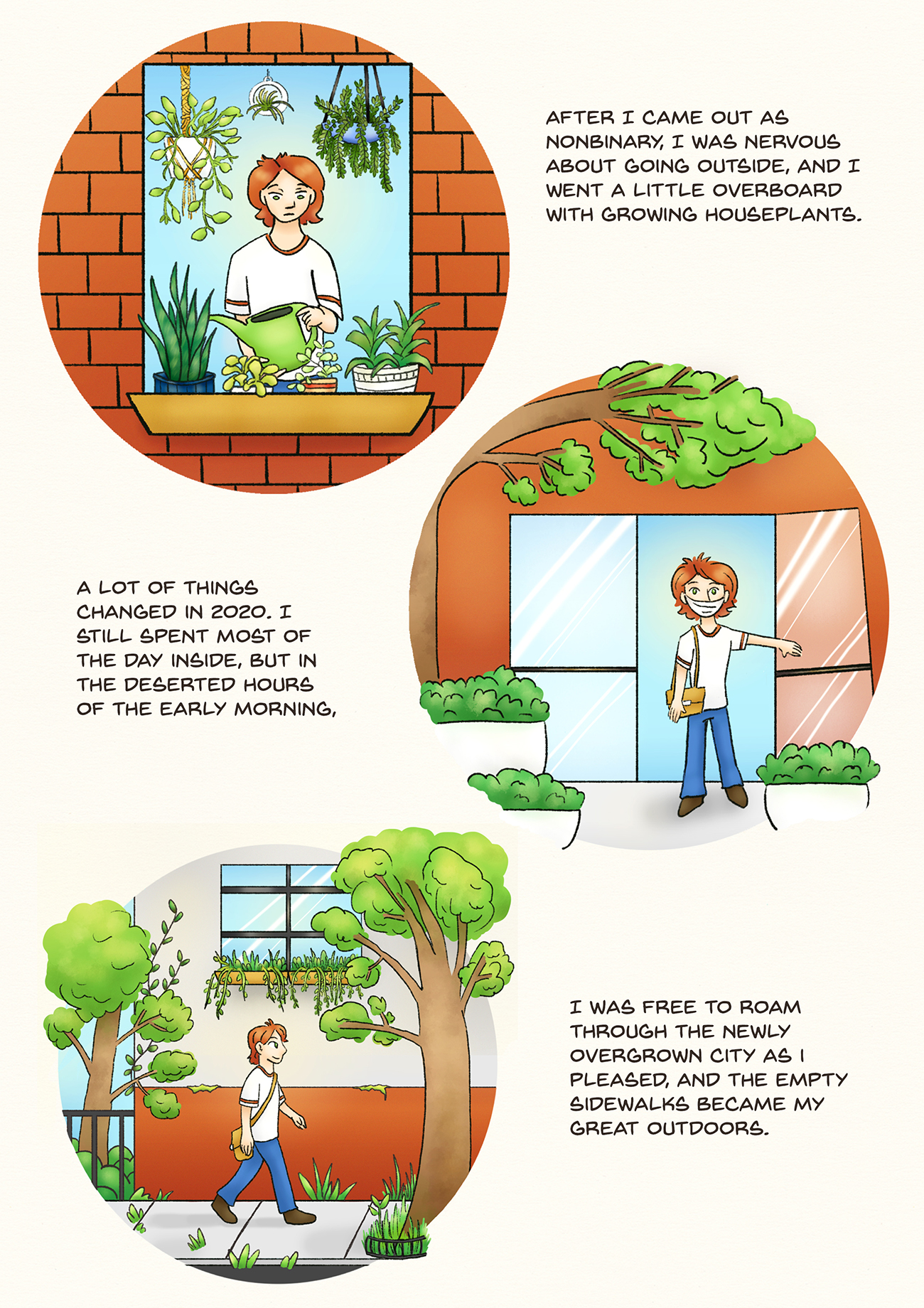
My Great Outdoors

When I moved to West Philadelphia at the beginning of the pandemic, the neighborhood was a mess. The city sanitation workers were on strike (good for them!!), and trash was everywhere. No one had trimmed the vegetation growing along the sidewalks, and there were all sorts of weeds and flowers pushing their way up from underneath the piles of loose rubbish. Most of the university students and faculty had evacuated the city, and no one was walking around outside to begin with, so the crows and opossums had gotten bold. It was quite nice, actually.

I don’t intend to suggest that there was anything “good” about the pandemic, which was and continues to be a nightmare, but I have to admit that it was still a welcome relief to be able to walk around outside while feeling like I was just another part of nature.

. . . . . . . . . . . . . . .

This is a comic I created for the third issue of Nature Held Me Close, a zine about “gender dysphoria and the great outdoors.” Free digital copies of all three issues of the zine are available on its website (here).

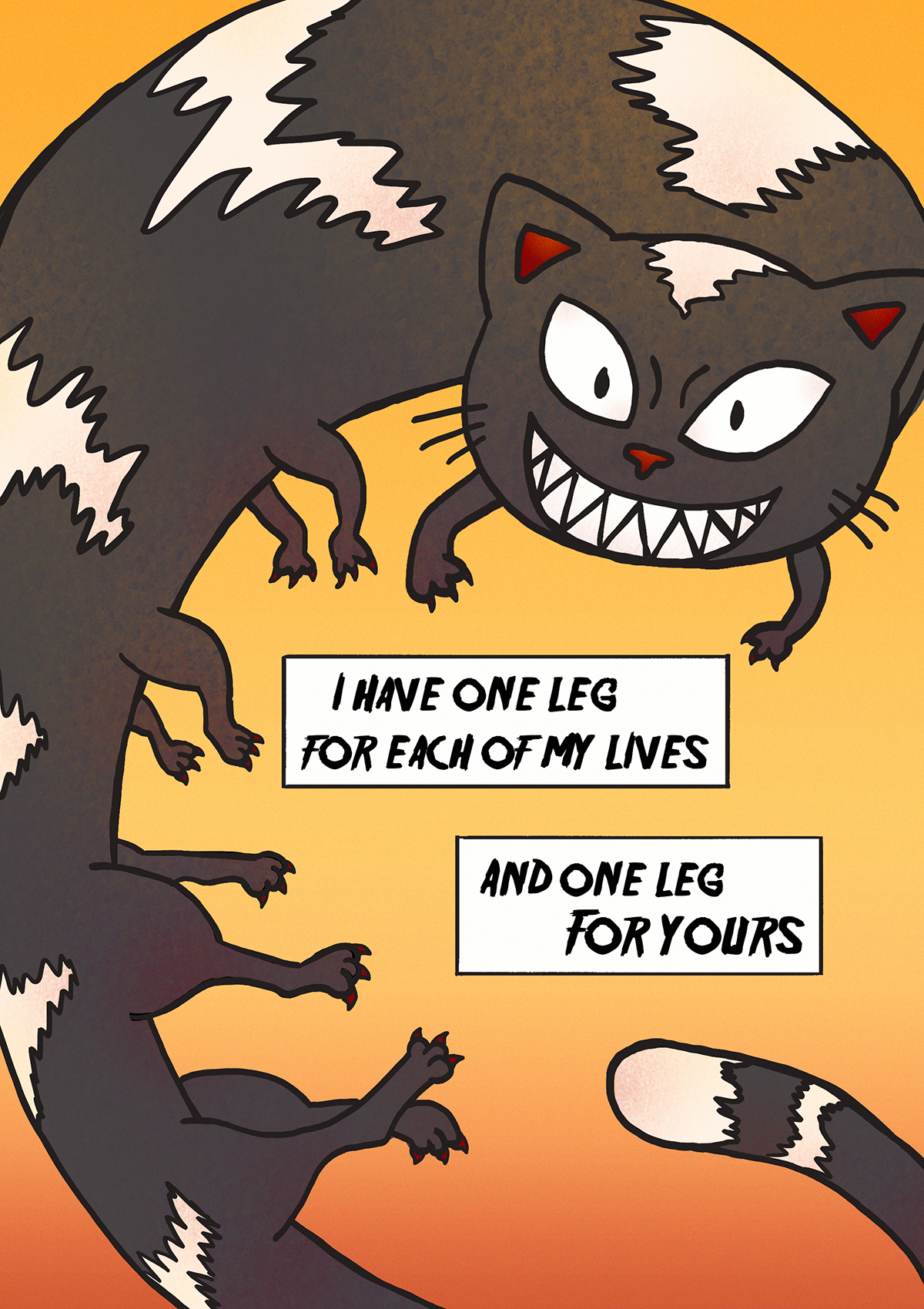
Felis Decapoda

I spent part of my childhood in rural Georgia in an old farmhouse that my mother went into bankruptcy to refurbish and remodel. Along with antique furniture, my mother collected stray cats, and at several points we had more than two dozen roaming around the house and yard.

I know that living in an historic farmhouse filled with expensive furniture and cats sounds like a dream come true for many people, and presumably this was the case for my mother. For me, however, it was extremely uncomfortable. I could never sleep properly, and I used to have nightmares about the cats eating each other and merging into giant mega-cats with far too many legs.

I don’t have anything against cats, and I’d like to adopt one of my own one day, but for the time being I’m happy being a dog person.

American Dream, New Jersey

True to my ambition to visit abandoned malls in New Jersey once I got vaccinated, I went to the American Dream mall in East Rutherford.

The mall is located across the river from Manhattan on a gargantuan plot of land that’s been in development since 2003, and you can get a good eyeful of the massive scale of complex while driving on I-95 towards the entrance of the Lincoln Tunnel. From what I understand, the state of New Jersey has been working with various developers to create an attraction that will draw consumer spending money from the city and convince out-of-town tourists to spend the night in a hotel in New Jersey instead of New York, and the amount of money invested is in the billions of dollars. Chris Christie, the former governor of New Jersey, allocated hundreds of millions of dollars of yearly subsidies into the seeing the development completed, which allowed it to project an opening in early 2020… and then the pandemic hit.

Parts of the mall are still under construction, and not all of its retail spaces are occupied, but it’s now open to the public. It is very new and very shiny. The pure white walls and floors gleam under soft white light, and there are fresh-cut flowers and public art everywhere. The empty storefronts and closed-off corridors are hidden by paneling covered in unique and gorgeous graphics, and there are all sorts of interesting pieces of modern furniture in the atrium areas. The soap in the literally sparkling-clean bathrooms is high-quality foam that smells like a garden in springtime.

The shopping seems to be relatively upscale, and the anchor stores are European chains like Primark and H&M. It’s not open yet, but there’s going to be an H-Mart in the basement, which I think is probably a nod to the East Asian retail strategy of having fancy grocery stores in shopping centers. It seems that the mall is also going to have a “luxury wing,” but it hasn’t yet been completed. They’re probably going to charge for parking in the future, but right now it’s free.

What makes this mall unique is that it also has a snowboarding hill, an ice skating rink, two mini golf courses, a Nickelodeon-branded theme park for little kids, and a huge and beautiful DreamWorks-branded water park in a huge and beautiful tropical biodome. There are a few other attractions that are still getting set up, like an aquarium that looks like it’s going to fit the aesthetic of being huge and beautiful and heavily themed in an offbeat artistic way that appeals to younger kids. If I understand the map correctly, the aquarium will have a giant ocean tunnel that will let you walk through a fantasy of a postapocalyptic underwater New York City, which is a bit morbid but still pretty cool.

And this entire place is completely empty. Just, completely empty. Except for a skeleton crew of retail employees at the stores and a few maintenance staff tending to the plants and flowers, there’s no one in the mall. American Dream looks like the international terminal of an airport if humans were to suddenly disappear from the face of the earth – very shiny and modern and clean, but deserted.

Anyway, now I’m wondering how you get the job of being a member of the gardening staff at a high-end abandoned mall that was a ruin before it even opened, because the people I saw tending to the plants and misting the flowers looked very peaceful and happy. It was some next-level Studio Ghibli magic, like Castle in the Sky except real.

If anyone asks, being a gardener in the ruins of capitalism is very much where I would like to see myself in five years.

We Should Improve Society Somewhat

This is my take on the viral Matt Bors comic. Someone actually said this to me about two years ago, and since then their comment has been living in my head rent-free. With this comic I hereby evict that unpleasantness and release it back into the wild.

I started drawing this comic earlier this year and finished it just to get it out of my drafts folder. In the time since I completed the line art, I made a firm decision to limit the negativity I post on social media. To be honest, most of the experiences that have had a major impact on my life during the past several years have been negative, but I’m not sure there’s any real use or meaning in representing them directly through autobiographical essays and comics. Instead, I’ve found much more satisfaction and catharsis in constructing analogies through the medium of fiction.

Also, I think there are a not insignificant number of people in the world (including the “yet you have a job” person) who tend to latch onto negativity to make bad-faith arguments about topics that could benefit from more nuance. Now that I’m at a stage of my life where I’m considering working on more collaborative projects, I’d prefer to keep that sort of interpersonal drama to a minimum. Thankfully, I’m in a better place now than I was when I started drawing this comic, and I hope the person who wrote this in response to one of my essays is in a better place too.

Still – fuck capitalism.

Whisper of the Heart


My husband is a fan of European football, and he spends a lot of time scrolling through football Twitter under a pseudonymous throwaway account. Most of the accounts he follows are British. He got annoyed with not being able to watch the region-locked videos people linked to, so a week or two ago he set up a VPN. (If you’re curious, he uses ExpressVPN, which is $8 a month and seems to be working nicely for him.) His computer now registers as being in the UK, and he employs this for the nefarious purpose of watching a few minutes of football videos a day and being amused by the British ads that Twitter shows him (mostly for snacks).

Even though he doesn’t use it much these days, my husband never stopped paying for his Netflix account, and it recently occurred to him that, with a UK address, he could watch British Netflix.

So the other day I was standing in the kitchen waiting for tea to brew, and my husband was sitting on the couch looking at Netflix UK. I asked him if he’s found anything to watch, and he started complaining that Netflix keeps trying to show him animated movies. He told he that they look Japanese.

I was like, “Okay, yes, go on.”

And he was like, “Have you ever heard of Studio Ghibli?”

That’s when I realized that my husband had never heard of Studio Ghibli.

. . . . .

My husband enjoys movies, but he’s in his forties and comes from a country where there hasn’t been a culture of anime fandom until relatively recently. He likes the Makoto Shinkai movies we’ve watched, which he calls “documentaries about Japan,” so I thought that Whisper of the Heart would be the best Studio Ghibli movie to show him. He loved it.

I loved it too. It’s been about ten years since I last saw Whisper of the Heart, and I was not expecting it to hit as hard as it did.

Whisper of the Heart is about a middle-school girl named Shizuku who loves reading. Shizuku checks out books from the local library, and she’s noticed that there’s another kid’s name on almost all of the library borrower cards inside the covers of the books she reads. She ends up meeting this boy, who is her age but wants to study the craft of violin making in Italy instead of matriculating to high school. Inspired by his determination to follow his dream, Shizuku decides to follow her own dream of writing a fantasy novel.

Shizuku gets really absorbed in her writing. She tells a friend that she has no appetite because she’s too preoccupied with her novel, and then she eats shortbread cookies so she can stay awake while she’s writing in the evening. She stops hanging out with her friends after school so that she can fantasize about her novel while walking home. She only puts in the bare minimum of work necessary to get by at school, and her grades drop. She gets explosively irritated when people interrupt her while she’s writing. When she’s done with the story, she gets super neurotic about feedback. She cries a lot.

I was just sitting there, like, “Oh my god. Oh my god. Oh my god.”

How dare Hayao Miyazaki come into my house and call me out like this.

. . . . .

The range of what my husband does and doesn’t know about internet culture is a mystery to me, so I was surprised when he asked me if the anime girl from the Lofi Hip Hop Radio channel on YouTube is modeled on the protagonist of Whisper of the Heart.

The answer is yes, of course she is. This reference is so obvious to me that I never thought about it as something other people might not get.

Because I teach upper-level seminar classes that don’t have any formal prerequisites, I spend a lot of time thinking about what my students do and don’t already know. I treat grad students like the educated adults they are, but it can sometimes be difficult to tell with undergrads. At George Mason, most of the students were either immigrants or the children of immigrants, but they had all gone through American public high school, so I could assume that they were vaguely aware of certain cultural touchstones. At UPenn, on the other hand, the students who went to public high school in America might actually be a tiny minority. Each new microgeneration of kids is going to create its own common knowledge base regardless of where they come from, so you have to be sensitive to that, but it’s just the nature of working with a large and heterogeneous group of people that there will be all sorts of things you don’t think about.

I went to college early, and then went to grad school right after college and got my PhD fairly quickly, so I was roughly in the same generation as my students for most of the time I was teaching. I’ve gotten older, though, as people tend to do. Now it surprises me when my undergrads are genuinely curious about Harry Potter because they’ve never read the books or seen the movies. Things I just absorbed by osmosis because I grew up with them are now units of knowledge that need to be explained, and that’s wild.

I can’t help but wonder if that’s what getting older is about – being able to pick up on more cultural references because I’ve had more years in common with the people who create media. And then I wonder when the cross-over point is going to be, like, when will I stop getting references because I’m so old that younger people no longer have any culture in common with me?

In any case, Whisper of the Heart is set in the 1990s but feels timeless. It’s still just as beautiful to me now as it was when I first watched it in college. The fact that the vast majority of anime fans under the age of thirty have probably never even heard of movie feels a little weird, but it’s also kind of nice. It’s wonderful that amazing stories were created in the past, but the genius and creativity of past work doesn’t need to be a burden, as there will always be cultural room to create stories in the future that build on the past but still feel fresh and new to each generation.
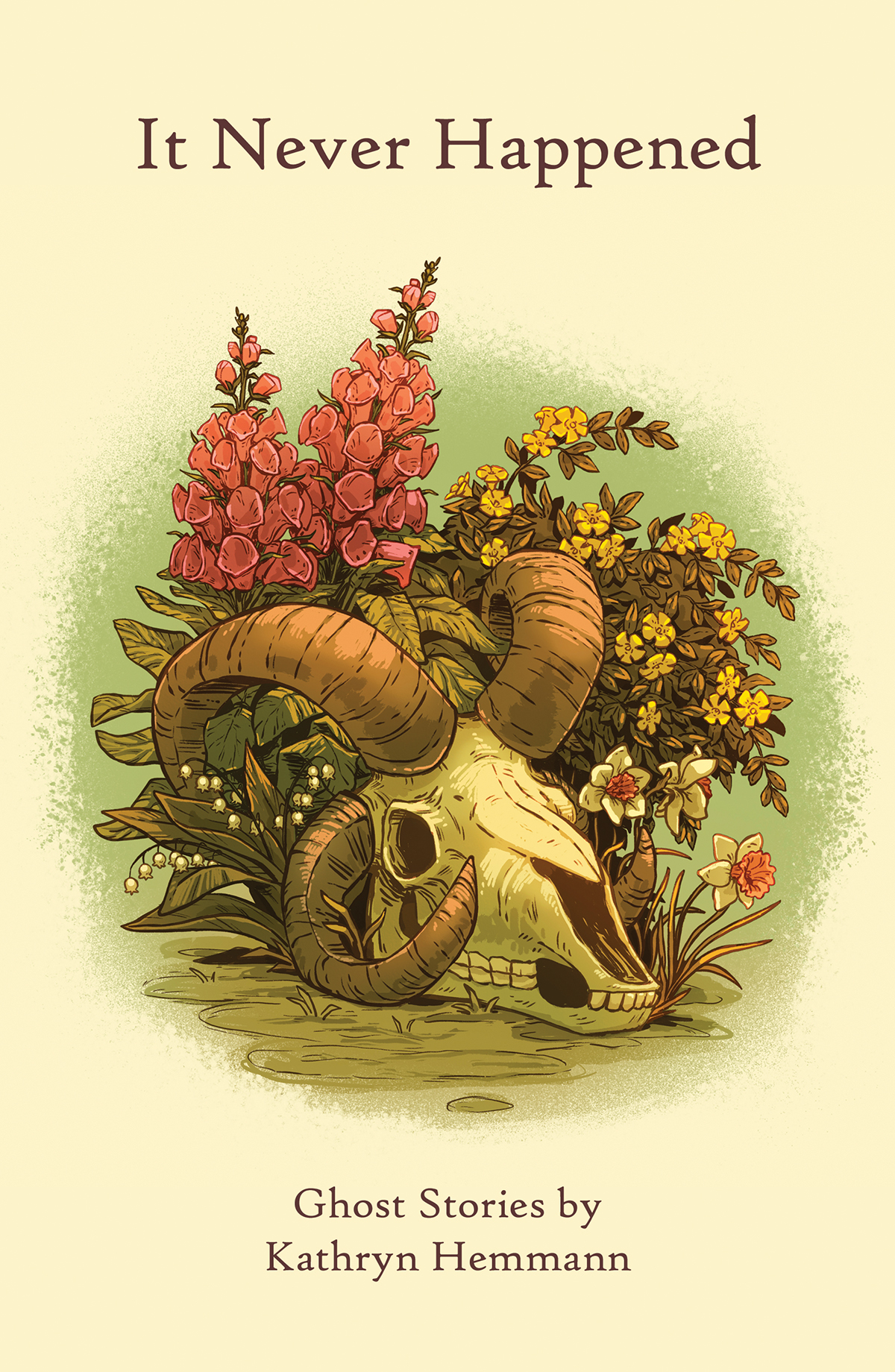
It Never Happened

It Never Happened is my second zine of horror-themed flash fiction. It collects fifteen very short stories, as well as a spooky comic (that you can find here) by the artist Frankiesbugs.

This is the zine description:

This zine collects fifteen short stories about finding oneself in strange circumstances and adjusting to a new normal. Nothing that takes place in these stories actually happened, of course. Most of what transpires is a little creepy, but it’s important to remember that none of this is real. If you read these stories, you might not be real either, but don’t let that stop you.

I love autobio comics, and a lot of these stories came from my failed attempts to write comic scripts. What I realized during this process is that it’s very difficult for me to talk about myself. Although I obviously have no trouble sharing my opinions, I never know what to say when I try to describe my own life. All of the stories in this zine are based on real experiences; but, as the title suggests, none of this ever actually happened.

Or rather, that’s not entirely true. One of these stories is 100% factually accurate, but I’m not going to say which one.

If you’re interested, there are still a few copies of this zine (on Etsy).

We Don’t Live in a Patriarchy

In the spring of 2014, back when people still used Facebook, I came across a post from a male friend who was a grad student at a West Coast school known for its progressive social climate. He had put together a proposal for an event with a female grad student in his department. She sent the proposal to their department chair, who returned it with a brief comment saying that it was unprofessional of her to submit such a shoddy piece of work. My friend and his colleague therefore sat down together and rewrote the proposal. This time he submitted the papaerwork, and the department chair congratulated him and told him that their administrative assistant would be in touch soon to help set up the funding.

When my friend forwarded this response to the female grad student, she pointed out that, lo and behold, he had made a mistake and attached the first draft – the very same one that she had submitted the first time around.

My friend was upset, as he rightly should have been, that such an obvious display of sexism could happen at his Progressive Liberal™ institution. I replied with “I blame the patriarchy” as a comment on his Facebook post and then thanked him via DM for being a good ally and talking about this in a semi-public space.

I didn’t think too much about this exchange until I got a notification that someone had replied to my comment on his post. A white woman around our age, who was a grad student herself, wanted to let me know that she objected to my use of the term “patriarchy.” She threw the Merriam-Webster dictionary at me, saying that, if “patriarchy” is defined as a “social organization marked by the supremacy of the father in the family,” then we haven’t lived in a patriarchal society for a long time.

I literally saw red when I read that.

Within the space of ten minutes, I had posted more than a dozen responses to her comment, each of which cited and linked to accredited sources of statistics strongly suggesting the male dominance of various political, economic, social, religious, and cultural fields in the United States.

When I came to my senses, I sent a DM to apologize to my friend. He got back to me right away, saying that my responses were important and asking me not to delete anything. I thanked him again and then took a nice long break from the internet.

I was still upset a week later, though, so I copied all of the text from my responses to that comment on Facebook and made a zine that I called “We Don’t Live in a Patriarchy.” Several dozen of my friends (and friends of friends) wrote to ask me for a copy. I also took copies from three print runs to Quimby’s Bookstore in Chicago within the span of two months, and I sold out of all the remaining copies almost immediately after I put them on Etsy. I think I probably ended up giving away or selling more than a hundred copies of this zine, which I found surprising, especially given how quickly put together and cheaply made it was.

The world has changed since the spring of 2014, but not as much as you’d expect, and not always in a sane and reasonable way. I’ve considered updating this zine several times, but I always decide against it. The truth is that I dislike being angry. I feel like anger is a tool that no one person can hold for an extended period of time, so it gets passed from one feminist to the next like a baton. I made my angry feminist zine back in spring 2014, and now it’s time for me to step back so that the next group of young people can speak and be heard.

Horror Haiku

In the spring of 2014, I made a half-letter size photocopied zine that collected thirty horror-themed haiku. I had so much fun putting it together that I made a second issue the very next week. I was teaching at Notre Dame that year and driving to Chicago practically every weekend to stay sane, and I spent a lot of time at Quimby’s Bookstore in Wicker Park. I took a handful of zines to Quimby’s to ask if they would take them on consignment, and they agreed. This turned out to be an incredibly transformative experience for me.

I was expected to teach a course on Japanese cinema during the spring semester, so I spent the summer and fall reading recent issues of about half a dozen different Cinema Studies journals from cover to cover. There are a number of excellent independent theaters in Philadelphia (and Tokyo), so I’d watched a lot of movies during grad school. I was excited about movies, and I was excited about Cinema Studies. I was also high off the experience of having finished my dissertation, so I ended up being very productive and writing a handful of essays about horror movies, which I sent to the specific journals whose articles and general editorial voices inspired me.

Everything I wrote was rejected without even going to peer review. Because the editors felt no need to be anonymous, they told me exactly why they rejected my work, and I knew exactly who they were.

Basically, I am gay and I love monsters, and I was looking at horror films from the perspectives of Queer Studies, which was a major focus of my dissertation, and Disability Studies, which was just starting to emerge as a discipline at the time. What one older straight white man after another told me was that, while my essays were well-written and skillfully argued, I lacked the “critical distance” necessary to engage in serious scholarship in Cinema Studies. Also, because I was writing about East Asian cinema, DO NOT GET ME STARTED on the racism I encountered. (I’m especially looking at you, British academics.)

I should have pushed back or tried to reach out to other female and female-identified scholars who wrote about East Asian cinema, but what I ended up doing was crying. I cried kind of a lot, actually. I cried and watched movies and wrote a bunch of horror haiku, which eventually became these two zines.

When Quimby’s agreed to put my zines on the shelves of their store, it gave me the courage I needed to keep writing. It’s not that my work wasn’t worth being read; it’s that I was trying to get it past the wrong gatekeepers. Once I realized that a smug rejection from some narrow-minded older white man didn’t mean that there was something wrong with my writing or scholarship, I started submitting to different venues and, thankfully, getting my work published.

Zines have historically served as a platform for minority voices that have been denied expression in mainstream and more traditional venues, and that’s how they worked for me. Honestly, Quimby’s Bookstore probably saved my academic career. Be gay! Make zines!!

Both of these zines have long since sold out, but you can still find my old horror haiku (here).

My Mother’s Cats

My first zine, which I put together in the spring of 2014, was made with a single sheet of copy paper and a construction paper cover. It had eight pages with simple illustrations of my mother’s cats.

My mother has (and has always had) twenty cats. When I went home for Christmas in 2013, I took pictures of them in an attempt to learn their names. I wasn’t successful, but the photos turned out to be useful references.

This was a fun zine, but I don’t think I’ll make any more of them. I no longer have access to a photocopy machine, and using scissors and a glue stick to create the cover by hand doesn’t seem as exciting and creative to me now as it did five years ago.

I’m thinking of making another zine with actual photographs, though. Caring for twenty cats may seem extreme, but my mother is very good at it. All of her cats are gorgeous, and they’re very photogenic.

DC Zinefest 2019

I tabled at the DC Zinefest this past Saturday, and it was a positive experience.

I sold out of almost all of the zines, bookmarks, and stickers I brought, and I was able to use that money to buy zines from the other people tabling at the event. I love zines, and I love the subculture surrounding zines. It’s good to support other writers and artists, and it’s always nice to smile at someone and look them in the eye and tell them how much you value and appreciate their work.

The Zinefest staff were wonderful. I tend to get overwhelmed by the crowd at events like this, so it’s important for me to be able to step back and spend a few minutes in a relatively calm space. I think the people who organize DC Zinefest understand that everyone needs a quiet place, so they set aside a small, screened-off area at the back of the room where people could chill out for a bit without bothering anyone.

My experience with anime conventions has been that the staff are primarily focused on crowd control and therefore operate under the assumption that aggressive confrontation is the best way to minimize trouble. This has led to some awkward situations when I’ve given panels at anime cons, so I appreciate that the DC Zinefest staff took it for granted that everyone who participated was a responsible adult, and I’m grateful that the organizers were willing to provide simple accommodations in good faith.

This was the first time I’ve tabled at an event like this, and here are some things I learned:

– It’s good to have some sort of vertical display for your zines. I’m not a huge fan of the elaborate fortresses constructed by some of the professionals who table at anime and comic conventions, but a low-key vertical display uses space efficiently and helps catch the eyes of people casually walking through the room. I’ve seen a lot of variations of these displays, and I get the feeling that a lot of structures are made by the artists themselves. I only trust myself enough to put together Ikea furniture, so it might be worth looking into where to buy a premade display if I table at an event like this again in the future.

– It’s good to incorporate short written descriptions of each zine into your vertical display. Some people used sticky notes, some people used index cards, and some people crafted display notes by hand. They were all cute and creatively presented, and they were useful to me when I only had a limited amount of time (and money) to look at other people’s tables.

– Along with written descriptions, it’s good to rehearse at least two different elevator pitches for each zine. It’s important to design zine covers that are able to speak for themselves, of course, but it’s also important to engage the people who stop by your table. A few people asked me questions that I didn’t know how to answer, and it would have been helpful if I could have said a sentence or two about the zine as a response, even if my description didn’t directly address what they were asking.

– A lot of people who stopped by my table were a bit awkward. That’s totally understandable, since going up to an artist’s or writer’s table is an awkward situation that takes some experience to get used to. Since I can sometimes be a bit awkward myself, I think it might be good to practice a few simple conversation starters, such as “I like your shirt” or “Do you like video games?” as preparation. It sounds silly to have to practice small talk, but I found that I got better at it with each passing hour. I was downright friendly by the end of the event, which makes me think that practice and experience probably help smooth over some of the awkwardness of this particular social interaction.

– It’s good to table with a friend, or at least to have someone who can drop by for an hour or two and give you a chance to walk around and stretch your legs. The floor layout of DC Zinefest is well organized and has enough room for people of all sizes, but I still think it’s a good idea to apply for a half table (instead of a quarter table) if you have more than one or two zines. If nothing else, a half table comes an extra chair, which means that anyone who comes with you will have a place to sit if they (or you) need it.

The only slightly critical thing I have to say about this experience is that I had a bit of trouble with some attendees – all adult men – who wanted to buy something for $1.00 and insisted on paying with Venmo. If you’ve never used Venmo, it’s a money transfer service that allows smartphones to communicate via QR codes and thereby complete transactions quickly, usually within five to ten seconds. What a few people (about one per hour) did was to make a big deal about having trouble with Venmo. They would make a scene and refuse to let me direct the transaction from my end, and I got the impression that they might have been trying to pressure me into giving them what they wanted for free. I understand that sometimes money transfers can be tricky, and I understand that sometimes QR codes don’t scan, but this happened so many times that I started to suspect something bigger was going on, especially since all of these Venmo “problems” were solved immediately as soon as my male tablemate stood up, spoke to these men at eye level, and told them that they could try transferring the payment to his account instead. The idea that grown-ass men would try to use some sort of stupid “my Venmo doesn’t work” scam to get a $1.00 sticker or bookmark for free at a local zine fest makes no sense to me, but something weird was going on.

Anyway, that’s another reason why it’s good to table with a friend – so that someone can play “bad cop” if an interaction seems as if it’s heading in a difficult direction.

Those minor instances of strangeness aside, I had a fantastic time. The organizers knew what they were doing, the staff was great, my fellow tablers were lovely, and the event was a huge success. I’m truly grateful that I was able to table at the DC Zinefest this year. I met some cool people, I made some good trades, and I came home with a bag full of interesting zines. I’m looking forward to next year!