I sometimes think about how Ganondorf more than likely didn’t start out as evil. I imagine that he probably went on a journey that paralleled Link’s, but his reaction to the secrets he found in hidden caves and forgotten temples was substantially different due to the circumstances of his life and destiny. While the Legend of Zelda games contain subtle elements of melancholy from Link’s perspective, Ganondorf’s story is more like a full-on Greek tragedy.
None of the lessons from the Gerudo Classroom have prepared Rhondson for married life with Hudson, who has grown restless and disappeared from Tarrey Town a year after its founding. She travels to the Akkala Citadel Ruins to hunt for her husband while reflecting on the bridges that will need to be rebuilt in order for Hyrule to embrace a peaceful future.
“A Noble Pursuit” is a short story that explores the theme of cultural differences, including different attitudes regarding the preservation of historic sites, via the Akkala Citadel Ruins.
As the Gerudo tailor Rhondson crosses the Sokkala Bridges, she’s impressed by how sturdy and practical they are; and, at the end of the story, she considers how building more bridges – both literal and cultural – might help make the Akkala Citadel habitable once more.
At the end of the story, Rhondson finds that her missing husband Hudson has made friends with the monstrous Hinox who’s always snoozing away on the citadel’s parade grounds. She realizes that both the Hinox and her husband need a renewed sense of purpose, and she encourages Hudson to direct his energy into rebuilding the ruins of the Akkala Citadel into a place better suited to cultural exchange.
This story about archaeology, castles, ruins, giant monster friends, and what it means “to live happily ever after” was written for Memorabilia, a Breath of the Wild fanzine that you can check out on Twitter (here) and on Tumblr (here). The accompanying illustrations are by the stylish scholar Pocketwei, whose art of handsome characters and beautiful landscapes can be found on Twitter (here) and on Instagram (here).
I saw a screencap of (this tweet) circulating on Tumblr after watching the recent teaser trailer for the Breath of the Wild sequel, and this is where my mind immediately went. People in the Legend of Zelda fandom say that they want “hot dad Ganon,” but be careful what you wish for!
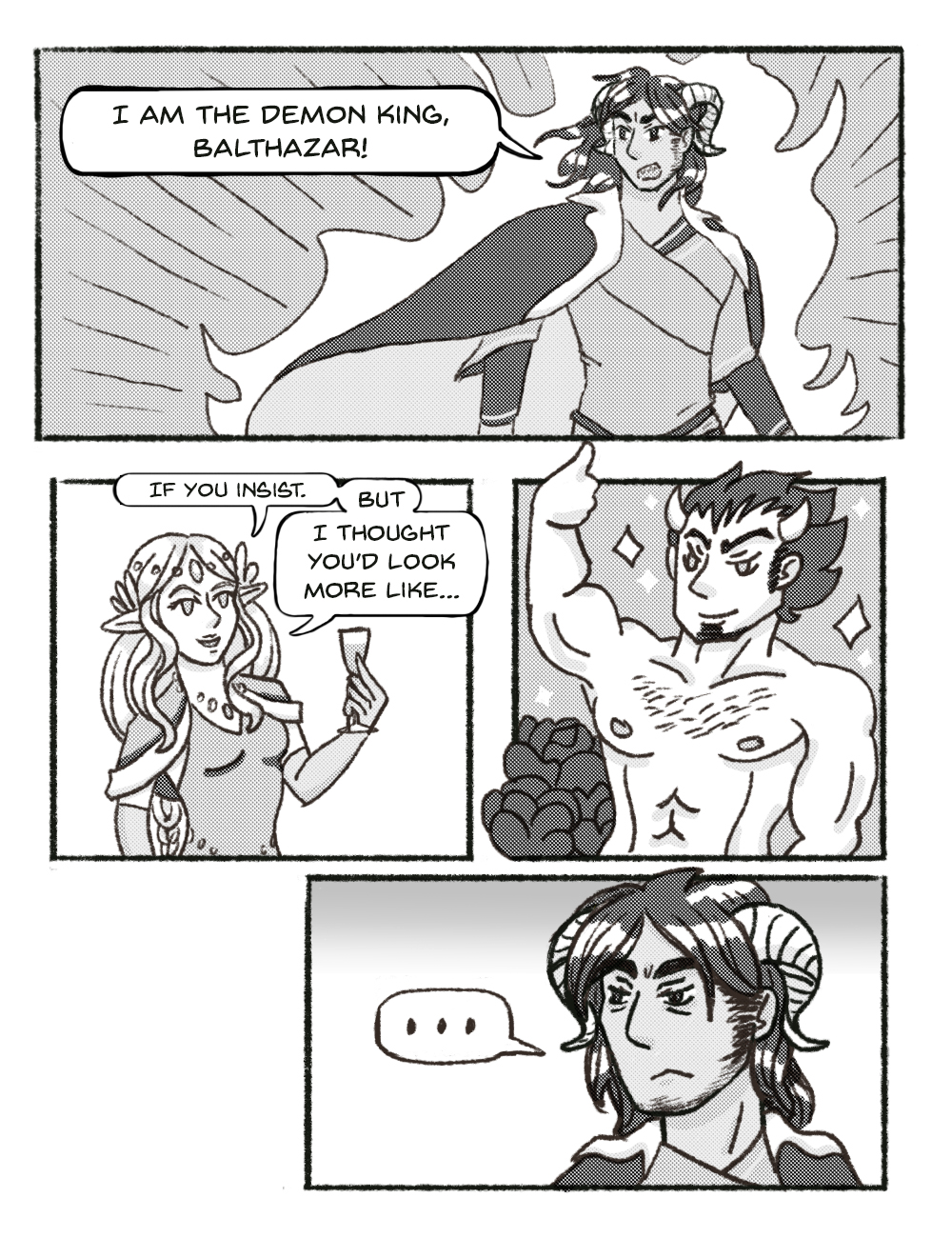
I’d like to extend my sincere gratitude to Frankiesbugs for putting up with my awful dad humor and drawing this silly comic. You can find more of the artist’s cute and creepy comics and illustrations on Instagram, on Tumblr, and on DeviantArt.
Malice is an urban fantasy AU of Breath of the Wild starring Zelda, a scientist researching ancient technology, and Ganondorf, a tech investor who takes an intense interest in her work. Ganondorf is more than he seems, however, and Zelda is about to learn just how real her nightmares of calamity might become…
Gin and cranberry juice is a healthy way to start a magical day.
Ceres is my take on magical video game princesses, and it is my headcanon that all of these ladies are consummate day drinkers. I think you’d probably have to be in order to summon the emotional fortitude to deal with the shenanigans of heroes and villains on top of the everyday business of running a moderately large kingdom.
I’m going to start writing my query letter for The Demon King soon, so I’ve been thinking about how to describe the story, which has two parallel threads that unspool in alternating chapters. The eponymous “demon king” Balthazar (he’s not really a demon king) is the main point-of-view character, as it’s his actions that push the larger narrative forward, but the role of his “nemesis” Princess Ceres (she’s not really his nemesis) as a deuteragonist is equally important and will only become more important as the story progresses.
Balthazar’s plot arc in the first novella is simple: he says he will go to a temple and find a magical artifact, and he goes to a temple and finds a magical artifact.
Meanwhile, what’s going on with Ceres is more complicated and can’t be succinctly summarized.
Ceres opens the story by sending a hero to fight Balthazar. This “hero” is actually a convict whom she has effectively exiled, and she intends for Balthazar to dispose of him. He does so, but not before the hero kills two people and injures a third.
Back in Whitespire, Ceres grants a private audience to a viscount from an outlying territory who essentially asks to stop paying taxes. Ceres dismisses him, but she allows herself to be seduced by his daughter, who wants the viscount to step down so that she can manage her family’s estate. While engaging in an openly sexual relationship with the viscount’s daughter, Ceres realizes that the viscount is being manipulated by a shadowy anti-monarchist political faction. In an attempt to provoke the members of the faction to reveal themselves, Ceres orders the head of her intelligence staff to direct a covert attack on the viscount’s estate.
Members of a separate anti-monarchist faction, fearing that they will be blamed for this attack, offer a scapegoat in the form of an advanced student of magic – a grad student, basically – who has been distributing seditious tracts. Ceres has actually discussed the matter beforehand with one of the leaders of the grad student’s faction, who is her close friend (and happens to be the author of the ongoing series of romance novels that Balthazar is addicted to). She therefore exiles the student, ostensibly to die at the hands of the demon king but actually to study with his friend Melchior, a wizard from a foreign kingdom who has strong anti-monarchist leanings of his own.
Ceres has grown fond of the viscount’s daughter, and she doesn’t want her or her father to become pawns of court politics in the way that the grad student did. She therefore engineers a minor scandal involving the viscount, which serves as the excuse the daughter needs to transfer power away from her father.
At the end of the first story arc, the viscount and his daughter leave the castle alive and unharmed. Ceres hasn’t been able to figure out who was manipulating the viscount at court, but she’s content to have secured an ally in the viscount’s daughter, who will almost certainly manage her family’s estate better than her father.
All’s well that ends well, but the reader is left with the dangling thread of why Ceres is so amenable to the idea of deposing herself from her own throne. In addition, how does she know Balthazar, and why is she so friendly with him? There’s also the matter of Ceres having sent Balthazar a “hero” that he was given no choice but to murder. Balthazar alludes to the fact that this isn’t the first time Ceres has done this, which is even more disturbing.
At the beginning of the second story arc, probably at the end of the second chapter, Ceres is going to address this matter directly and reflect the main theme of the story back on Balthazar by saying that these “heroes” have a choice. What she means is that no one is forcing them to attack the people they see as their enemies, but this raises the question of whether Ceres is giving Balthazar a choice in how he handles the circumstances she has created. This digs even deeper into the story’s theme by suggesting that some choices aren’t so simple, and that people suffer when they try to deal with making these choices on their own.
Also I intend for Ceres to make a lot of jokes about oral sex in her second story arc.
This summary is much more complicated than the story itself, hopefully. Ceres is not an unreliable viewpoint character, and none of these plot elements are supposed to be confusing or mysterious to the reader.
In the end, the goal of all this political intrigue is to set up Ceres’s kingdom as a battleground while establishing that it is primarily a battleground of relationships and feelings.
If Balthazar is a means to look at high fantasy heroic quest narratives from a different perspective, then Ceres is my take on the traditional “pure-hearted princess” trope. Ceres is in her early thirties, and I don’t think a princess can survive that long in a position of near-absolute power without being extremely clever and at least a little evil.
The above illustration of Ceres was created by the stylish and magical Fernanda V. (@artesiants on Instagram and on Twitter + @artesiant on Tumblr), who draws bold and fashionable designs of witchy characters. The prompt I gave her was “an elven princess who is beautiful and ethereal but delights in destroying her enemies,” and I love how she’s mixed diaphanous skirts and delicate jewelry with a lightly armored Amazonian halter that leaves Ceres’s arms free and ready to handle any conflict that comes her way.
It’s so interesting to see how various artists interpret this character, and every illustration of her makes me even more committed to telling her story despite the occasionally stress-inducing intricacies of its twists and turns.
This is my take on the viral Matt Bors comic. Though Bors is depicting a caricature of obnoxious reply guys on Twitter, a surprisingly large collection of random people on Tumblr actually said this to me recently in response to an offhand post that the world wouldn’t end any faster if I didn’t reply to work emails on Saturday evening. Their reasoning seemed to be that it was hypocritical of me to push back against the neoliberal demands of constant work from the “privileged” position of someone who actually has a job.
Since then, their comments have been living in my head rent-free. With this comic I hereby evict that unpleasantness and release it back into the wild.
As I drew this comic, however, I made a decision to limit the negativity I post on social media, which includes this very comic itself. To be honest, most of the experiences that have had a major impact on my life during the pandemic have been negative, but I’m not sure there’s any real use or meaning in representing them directly through autobiographical essays and comics. Instead, I’ve found much more satisfaction in constructing analogies through the medium of fiction.
In addition, I get the feeling that there are many people in the world (including the “yet you participate in society” commenters I encountered on Tumblr) who will aggressively seek out and latch onto negativity specifically in order to make bad-faith arguments about topics that could benefit from more nuance. Now that I’m at a stage of my life where I’ve started to work on more collaborative creative projects, I’d prefer to keep that sort of socially networked negativity out of my space.
Still, even though I do in fact have a job, I’m not wrong. Fuck capitalism.
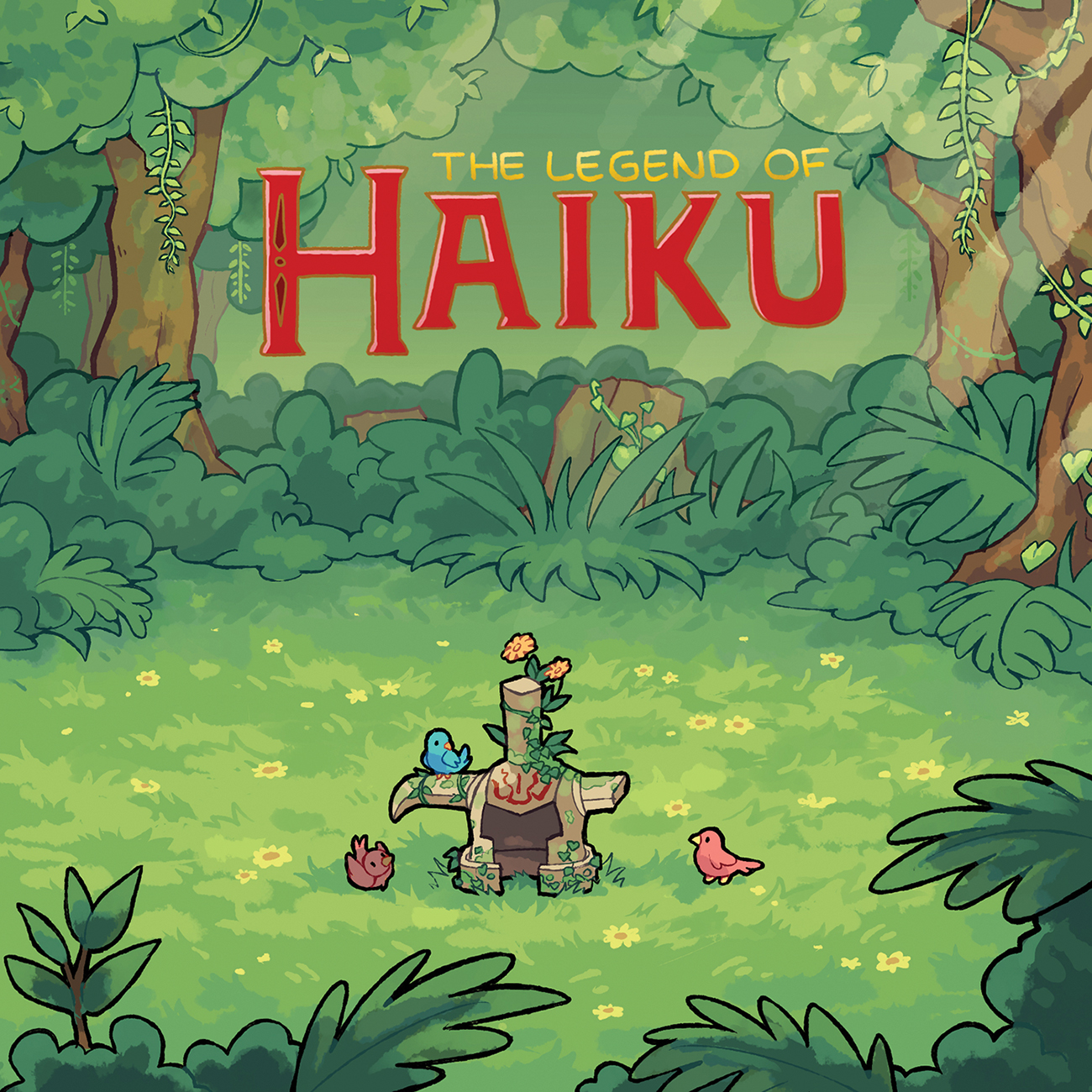
The Legend of Haiku celebrates the natural environments and quiet moments of the games in the Legend of Zelda series. This 46-page zine collects the work of 28 poets and artists from around the world who have pooled their talents to create a gentle adventure into a beautiful green world filled with mystery and discovery.
🌿 You can download a free digital copy on Gumroad (here). 🌿 There are a handful of physical copies available on Etsy (here). 🌿 You can download the digital zine directly from Google Drive (here).
This project was a journey. I had initially planned to release the zine in November shortly after the end of the submission period, but I received such an incredible diversity of submissions from such a large number of people that I found myself at a loss regarding the best way to move forward. In addition, the pandemic resulted in severe delays with the United States Postal Service, and I actually had to close my store on Etsy because nothing was getting where it was supposed to go. I therefore had to put the project on hiatus for three months, and I was only able to resume work in March.
If I learned anything from this process, it’s that most people are lovely and patient and kind. I was expecting to encounter more frustration, but everyone was very chill and nice.
I also learned that it’s good to take a big project like this in baby steps until I reach a sense of critical mass and can work for longer periods as I get a better sense of what needs to be done and how best to do it. I wasn’t prepared for the incredible response I got concerning this project, but I’m very grateful for the support of the contributors as I muddled my way through.
Thankfully, the zine turned out to be gorgeous, so it was all worth it in the end.
I want to give a special shout-out to the cover artist, who goes by @flyingcucco on Twitter and @acro_bike on Instagram. Trina was an absolute pleasure to work with, and she put an extraordinary level of thought and attention into creating a design that captures the themes of the project. The full, unedited wrap-around cover illustration was awarded the honor of being a Daily Deviation on the portfolio hosting site DeviantArt, and I highly encourage you to check it out (here) if you’d like to read Trina’s concise but insightful artist statement.
It is an anime truism that a villain is evil in direct proportion to how stylish and attractive they are.
We can therefore infer that Balthazar is neither good nor evil, as he is not particularly attractive and wears the high fantasy equivalent of a track suit jacket over pajamas.





 Digital Fantasy Diary