Necromancer Zelda

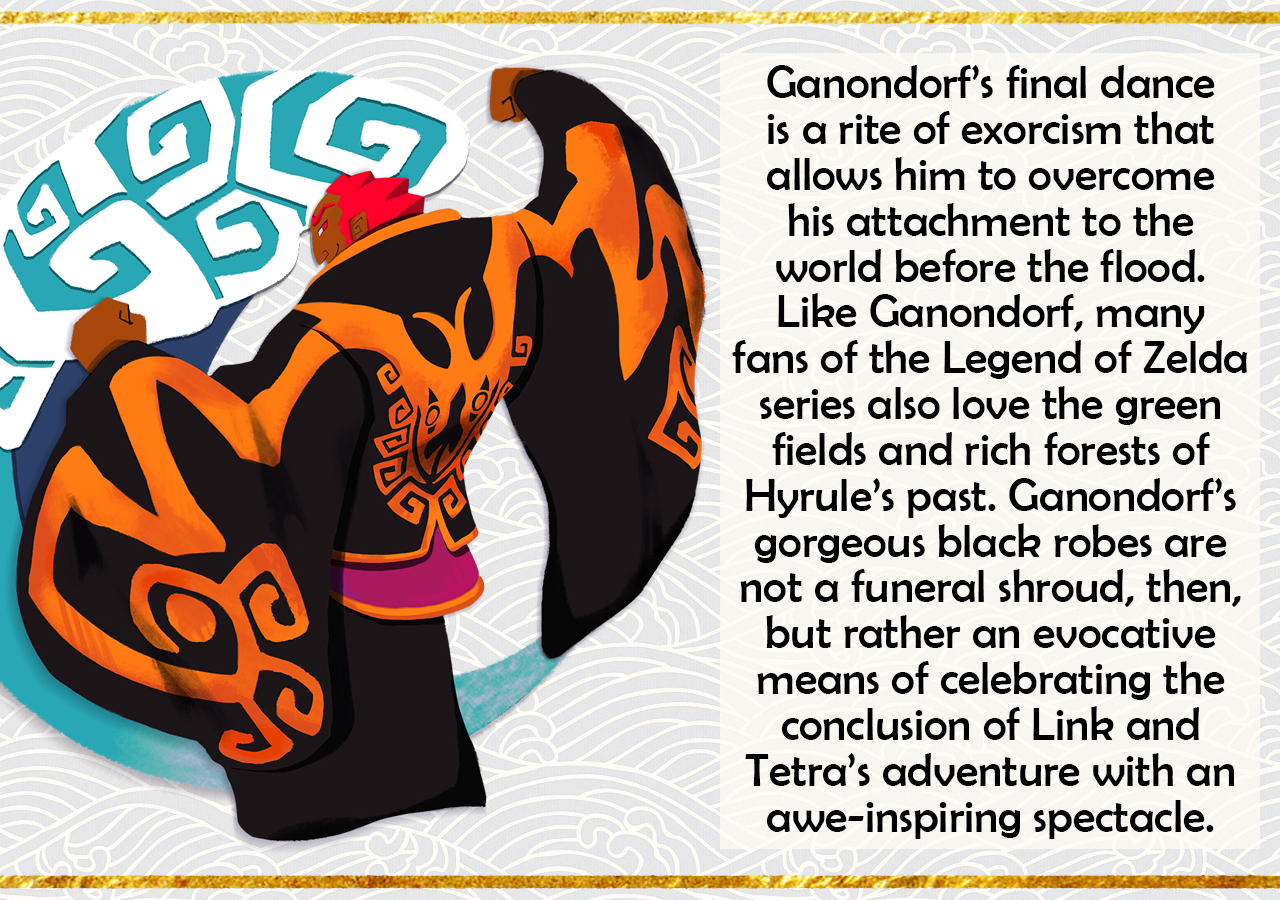
Echoes of Wisdom is growing on me, and I especially love how Zelda fights by rapid-summoning monsters to overwhelm her enemies. I suppose Zelda is technically creating “echoes” instead of resurrecting her defeated foes, but she still reminds me of the Tears of the Kingdom trailer in which Ganondorf triggers the Blood Moon, summons a bunch of monsters, and tells them to “sweep over Hyrule.” Necromancy seems like a very fun gig if you can get it.

This comic was drawn by the horrifically talented Frankiesbugs, whose cute and creepy illustrations and comics can be found on Tumblr (here), on Instagram (here), on Cara (here), and on Redbubble (here).

An Unfound Door, Chapter 10

After returning from the library in the east tower, Agnes and Fhiad immediately head to the door in the graveyard via a set of underground access tunnels for the castle staff. They enter the tunnel system through the ground floor library. Along the way, Agnes remarks on how all of the underground areas of the castle have been abandoned for decades. In the courtyard, Fhiad tries to open the door with magic but fails.

The next day, Agnes talks with her father, who is recovering from a lingering illness. He suggests that she should visit the castle’s west wing, which once hosted a world-renowned magic academy but has fallen to ruin after the war with Erdbhein. As she prepares to present herself at court that evening, Agnes reflects on the magic of the lost Soreiya’s Tear and thinks that her own wish would be to see Faloren before its decline.

.

Following two successive library explorations, this chapter is significantly more mundane. Agnes and Fhiad manage to locate the “unfound door” of the novel’s title, but Fhiad can’t open it. Agnes then talks to her father, the king, but he doesn’t know anything either.

The king points Agnes in a potential direction, but his advice is little more than his own wishful thinking. Much later on in the story, it will be revealed that Agnes’s father and mother spent a fair bit of time exploring the castle themselves. Although it may seem like Agnes’s father is an antagonist, he had dreams and ambitions once, and he loves his daughter in his own way.

An Unfound Door isn’t YA fiction – everyone in this story is an adult – but one of the staple elements of the genre of YA fiction that has always bothered me is how anyone over the age of twenty is automatically cast as a villain. I understand why it can be useful to set up “adults” as antagonists from a narrative perspective, but the idea that any given adult would have any actual power in real life is laughable.

Speaking personally, I feel like there are more limitations placed on me with every year I get older, and that’s the theme I want to express through Agnes’s father. Precisely because he’s a king, there are many things he can’t do. Still, when Agnes obliquely mentions that she’s taking up the quest he secretly began when he was younger, he can’t help but get excited. Agnes’s father isn’t a bad person; he’s just the hero of an entirely different story.

Also, although I love novels like those in the Redwall and Harry Potter series, I want to use the setbacks and mundanity of this chapter to challenge the fantasy genre convention that Agnes will be embarking on a fun adventure in a magical castle. I am not made of stone, and I’ve definitely enjoyed writing the adventure segments! Still, the point of this story is for Agnes to realize that her quest to save her kingdom isn’t what she should be doing with her life. Not everyone is meant to be a hero, and that’s okay.

The illustration in this chapter’s graphic was created by the magical Allison McKenzie, a Final Fantasy fan artist who draws colorful and expressive female characters who are always full of life. As you can probably guess from Agnes’s visual design, her character is partially based on Garnet from Final Fantasy IX, so I’m thrilled that Allison drew this illustration for me. You can check out her art on Twitter (here), on Instagram (here), and on Tumblr (here).
An Unfound Door, Chapter Nine

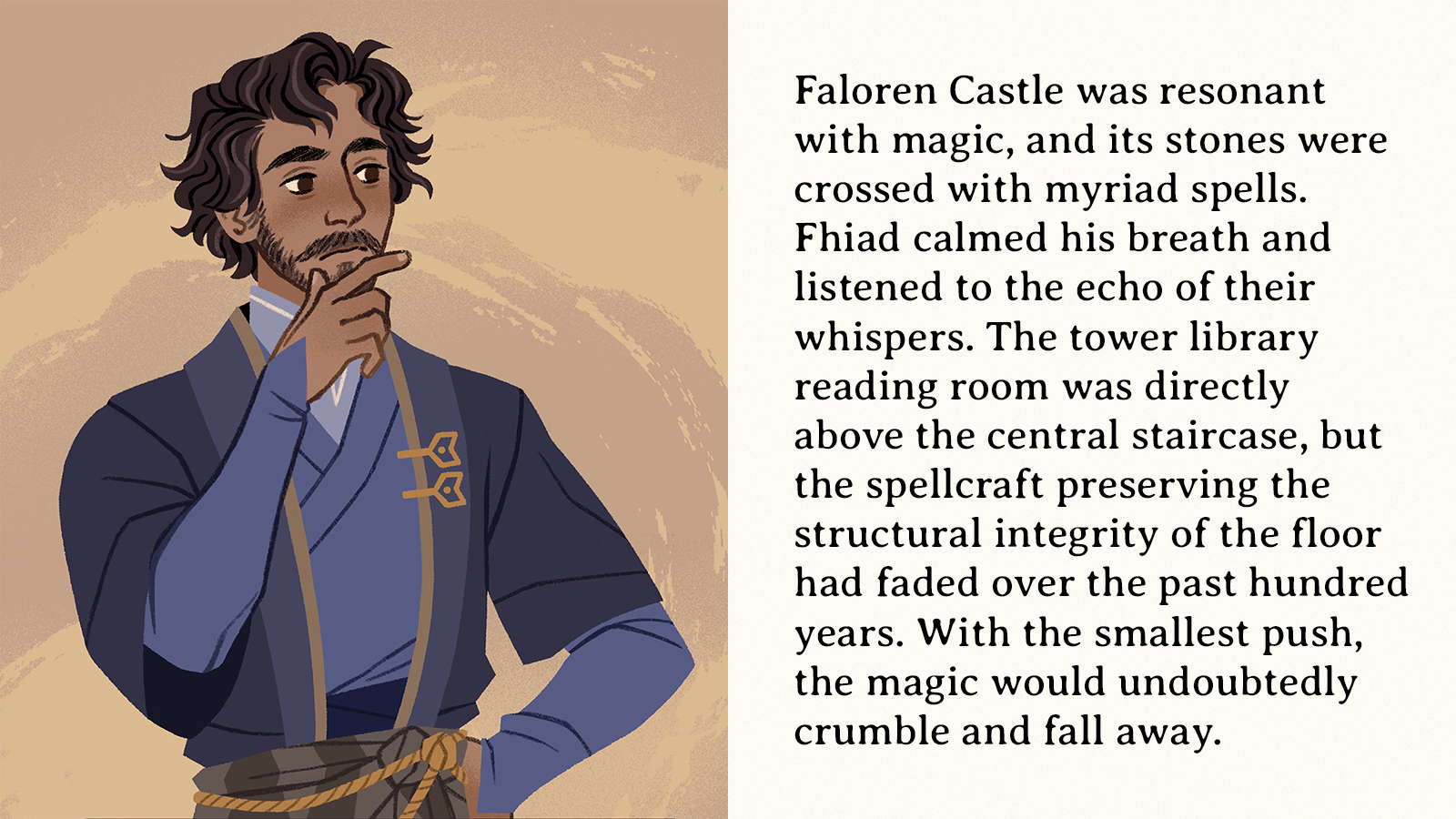
Agnes and Fhiad visit the magic library in the abandoned tower of the east wing of the castle, where Fhiad demonstrates the concept of magical “cost” to Agnes. Fhiad then locates a book about the castle’s architecture left in the library by Agatha, the princess of his era. He explains that Agatha was searching for a secret entrance to the castle’s deeper subterranean levels, where she believed Soreiya’s Tear was hidden. Fhiad shows Agnes an illustration of a door, and she immediately recognizes it as the entrance to a vault in the graveyard adjoining the north courtyard garden.

Fhiad is frustrated that Agnes was able to solve the problem so quickly, while Agnes is jealous of Fhiad’s relationship with Agatha. She snaps at him; and, in retaliation, he creates an entirely new staircase to the main hallway in a grand display of magic. Agnes is impressed, and Fhiad is pleased by her praise. They agree to visit the door in the graveyard immediately in order to see it for themselves.

.

There’s a tidy bit of plot setup in the chapter. This is where the reader learns about the weirdness going on between Fhiad and the princess of his era, and this is also where I introduce the eponymous “unfound door” of the novel’s title.  

This is the second chapter narrated from Fhiad’s perspective. When he sets part of the tower library on fire in order to adjust the castle architecture, he doesn’t remark on the fact that he’s doing anything unusual, but this is where it should become clear to the reader how exceptionally skilled he is. Agnes had a similar scene in Chapter Five, when it’s strongly implied that she’s keeping the bureaucracy of the royal household running almost single-handedly.

An Unfound Door isn’t a power fantasy, however. This is a story about the fall of empires and the gentle beauty of decay, and it ultimately doesn’t matter how talented the characters are. Both Agnes and Fhiad want to restore their kingdoms, but this isn’t possible, not even with their incredible skills. This isn’t a story about being strong and overcoming obstacles. That sort of narrative makes me tired.

I originally wrote this chapter in October 2023 before taking a long hiatus from the project. I returned to the novel this past April, and I’m pleased to say that the first draft is finished. Now that I’ve returned to the earlier chapters, it feels strange to see Fhiad and Agnes at this stage of their relationship. Even though I wrote this story myself, I have to admit that I’m looking forward to watching them gradually warm up to one another.

The illustration of Fhiad in this chapter’s preview graphic was created by the marvelous Emily Cheeseman, whose website is (here). You can follow her work on Instagram (here), and I recommend checking out her postcard club on Patreon (here). The general atmospheric vibe of An Unfound Door was partially inspired by Em’s graphic novella adaptation of Gawain and the Green Knight (here), so it was an incredible honor to have her draw one of my story’s main characters!

A Legend of Shadows

When calamity besets his home in the desert, the young prince Ganondorf is forced to journey abroad to seek answers in Hyrule’s ancient sanctuaries. Lost within the shadows of a temple deep in the forest, Ganondorf struggles with a burden he does not yet have the power to bear.

I wrote “A Legend of Shadows” for Hyrule Apocrypha, an illustrated storybook fanzine exploring the myths and lore of the Legend of Zelda series. I consider myself extremely lucky to have been be able to create a story illustration with Peregyr, whose green and magical art can be found on Twitter (here) and on DeviantArt (here). We had a great time imagining Ganondorf’s backstory as a failed hero. This is how the story opens…

What would you do if you weren’t the hero? What if the chosen one were someone else entirely? Would you curse the gods and lament your fate? Would you turn tail and go home? Would you try your luck elsewhere, in a distant land where no one knew your name? Or would you simply lay down your sword and give up? Ganondorf was beginning to suspect that he was no hero, but he was nothing if not stubborn. Giving up was not a choice he was willing to make.

You can read the full story on AO3 (here), and you can check out more of the work featured in the zine on Twitter (here) and on Tumblr (here). Leftover sales, which include some lovely Zelda-themed merch, are now open (here).

Sidequest Article on A Link Between Worlds

I had the pleasure of writing a fun article for Sidequest about how A Link Between Worlds is a perfect cozy horror game to play during the long summer evenings. It’s a dark twist on Legend of Zelda series traditions and one of my favorite adventure games.

If you’re interested, the article is here:
https://sidequest.zone/2024/08/05/spooky-zelda-game/

Many kudos to the magical LunarChibistry for creating the lovely artwork of Princess Hilda in the promo graphic!

Strange Things Happen in Philadelphia

Strange Things Happen in Philadelphia collects six short pieces of weird fiction about the past, present, and near future of a city where anything can happen. Philadelphia is simultaneously filled with decaying ruins and vibrant cultures, and I see the stories in this zine as a celebration of those of us surviving and thriving during the slow collapse of the American empire. Nothing in these stories is real, of course, but I’ve drawn them from a deep well of local folklore and hearsay.

To tell the truth, I don’t actually know that many people in Philadelphia. I lived here for most of grad school but then moved away to chase various academic jobs. I returned during the pandemic, which wasn’t a great time to meet new people or reconnect with old friends. I’ve tried to apply to local writing groups and workshops but haven’t gotten anywhere (yet).

Don’t get me wrong – I’m fortunate to enjoy the support of various writing communities online. Still, my personal experience of Philadelphia has been mediated by long solitary walks through parts of the city that have a lot of abandoned buildings, many of which have fallen to ruin.

One of these areas is my own neighborhood of Point Breeze, which is a lovely place to live but also filled with decrepit warehouses and other abandoned properties. I myself live next door to a derelict funeral home, and I’m constantly reading threads on various Philadelphia reddit boards about the struggles of homeowners whose townhouses adjoin similarly abandoned buildings.

It’s worth emphasizing that Philadelphia is densely populated. In fact, one of the reasons I love living here is that there are always people on the street at all times of the day and night. In a lot of ways, Philadelphia reminds me of Tokyo. It’s an affordable city with a lot of history, culture, and potential…

…but that’s not really what these stories are about. As I edited this zine, I realized that it’s pervaded by a sense of loneliness. Not an unpleasant loneliness, but rather the unique perspective afforded to a stranger. When you’re alone, you end up seeing things that perhaps other people might miss, and that sense of strangeness is what I wanted to capture in this collection.

I was fortunate to be able to work with Kaylee Rowena, an architectural wizard of the highest order, to create the art for the zine cover. The zine also features a spooky illustration of Mothman by an artist of the odd and surreal who goes by Gravemud on Tumblr, as well as a gorgeously aesthetic illustration of two elegant monsters by the brilliant and stylish Critter Crafter Ally. I’ve also included a half dozen of my own illustrations.

Unlike my previous short fiction zines, Strange Things Happen in Philadelphia is printed in full color, and I’d like to think it’s an attractive little book. If you’re interested, you can download a free digital copy from Itch.io or order a physical copy from Etsy.  

🌇 https://digitalterrarium.itch.io/strange-philly-zine
🌇 https://www.etsy.com/listing/1761448527/strange-philadelphia-fiction-zine

When the Moon Didn’t Fall

All the clocks in Clock Town have stopped working, and letters have stopped arriving from the Gerudo in the Great Bay. Both the clock master’s daughter and the swamp witches’ son sense that something is amiss. Slowly they come to understand one another while their world gradually winds itself apart.

When the Moon Didn’t Fall is a short novella that imagines what Zelda and Ganon would look like in the world of Majora’s Mask. According to the Legend of Zelda Encyclopedia, Termina only exists as a dream inside Link’s mind, and it’s interesting to analyze how the events and characters of Majora’s Mask reflect the trauma that Link experienced in Ocarina of Time. I therefore wanted to use Termina as a stage to explore the trauma of Zelda and Ganon, specifically within the context of a dream that’s rapidly fading.

I think it’s fair to admit that I was strongly inspired by Stephen King’s 1990 novella “The Langoliers,” which is a disturbing bit of speculation concerning what happens to the world of the past after the present has already moved on. I tried to capture a similar sense of time (literally) running out, a theme that felt appropriate to the anxiety-inducing atmosphere of Majora’s Mask. Like “The Langoliers,” When the Moon Didn’t Fall has elements of uncanniness and horror, but it’s also about forgiveness, healing, and hope for the future.

I originally wrote this story back in 2018, but it still holds a special place in my heart. I completed a substantial set of edits so that I could include one of the early chapters in my portfolio of writing samples for The Whispers of Hyrule, an upcoming Legend of Zelda fanzine celebrating Hyrule’s forests. I love the swamp forest bordering the open plains of Majora’s Mask, and I enjoyed revisiting the strange green spaces of Termina through this fic.  

You can read the full story on AO3 here:
https://archiveofourown.org/works/14093202/

The story illustration was created by the dangerously talented Thali, whose cool and creepy video game art can be found on Twitter (here), on Instagram (here), and on Tumblr (here).

Evil Gardening with Ganondorf

I always seem to find myself in a Wind Waker mood during summer. One of the many things I love about The Wind Waker is how beautiful and green and breezy it is. It’s a joy to spend time in the world of the game, which is filled with all sorts of strange and interesting creatures.

To me, then, it’s always been amusing that the Deku Tree in the Forest Haven blames this state of affairs on Ganondorf. I believe the implication is supposed to be that Ganondorf is so innately evil that his very presence on the Great Sea causes monsters to appear, but that’s extremely silly. Ganondorf may be up to no good, but he’s just a crabby old man.

If Ganondorf is responsible for the appearance of plant monsters, I prefer to think that this is because one of his many old man hobbies is gardening. Evil gardening!!

This comic was drawn by the darkly brilliant Frankiesbugs, whose cute and creepy illustrations and comics can be found on Tumblr (here), on Instagram (here), on Cara (here), and on Redbubble (here). Frankiesbugs is also responsible for the comic art and environment design featured in an upcoming beat-em-up game called V’s Rage. Like Wind Waker, V’s Rage boasts plenty of cute creatures, beautiful sun-soaked landscapes, and ridiculous middle-aged men. You can check out the game and play a substantial free demo on Steam (here).

An Elegy of Earth and Sky

An Elegy of Earth and Sky
https://archiveofourown.org/works/55003288

Long ago, in a time now lost to the ages, Hyrule was a formless void roiling with primal darkness. Seeing potential in this untapped energy, three goddesses descended from the source of light to shape Hyrule according to their will. They bestowed three sacred virtues upon their daughter before leaving her in the land they created, where the god of the earth waited to grant her a gift of his own.

I’ve been intrigued by the mythology of the Legend of Zelda games since I first read the fantastically illustrated story of Hyrule’s creation in the game manual for A Link to the Past, and I’ve enjoyed how games like Ocarina of Time and Skyward Sword have expanded on the divine cosmology of the series. I was frustrated by the lack of any foundational mythology in Tears of the Kingdom, so I decided to write my own version of Hyrule’s origin story. The first half is based on Hesiod’s Theogony, while the second half borrows from one of the stories about Izanami and Izanagi in the Kojiki. Hopefully this short story reflects the poetry of its inspirations!

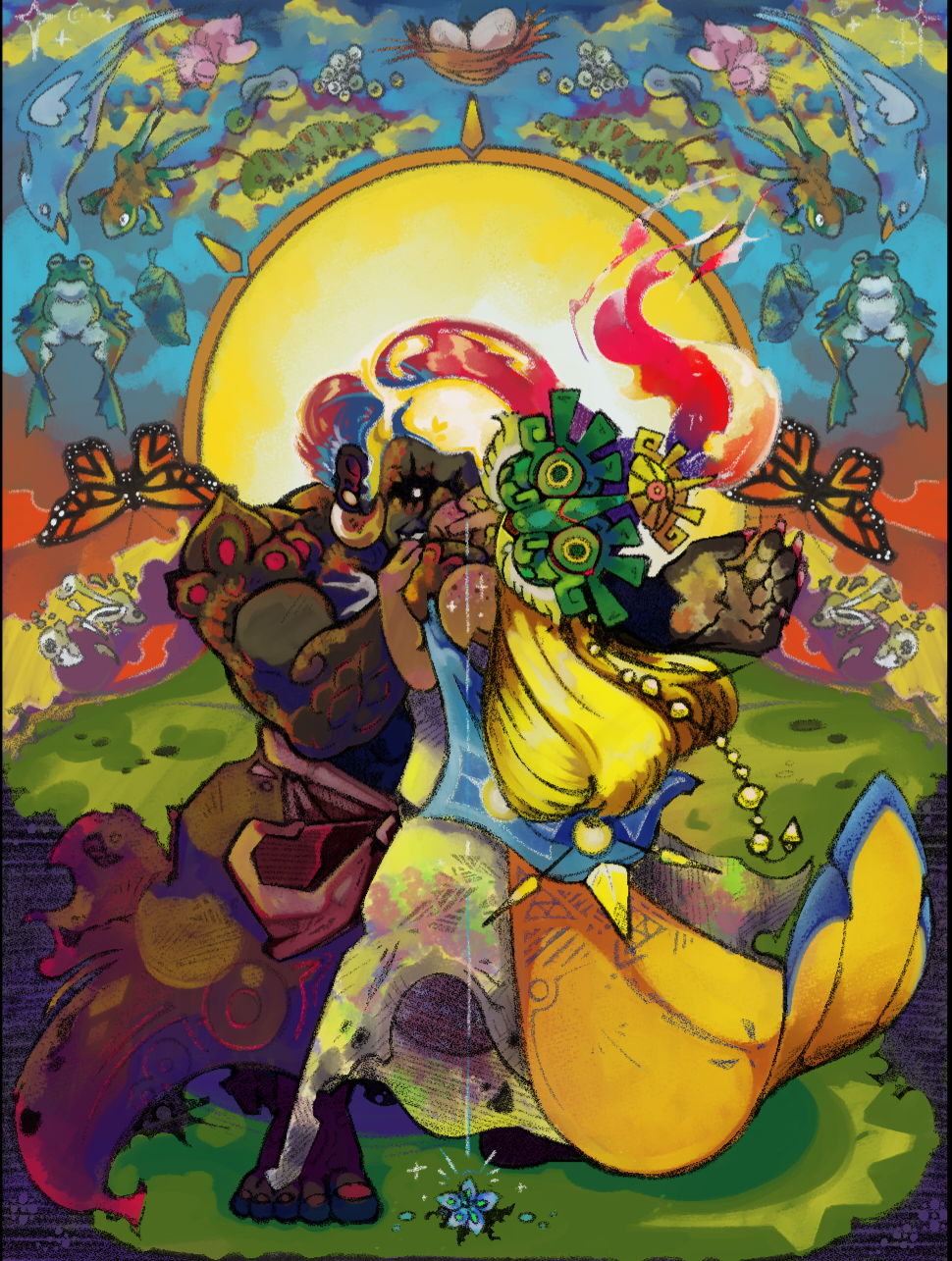
The illustration that accompanies this story was created by Hylias_Disgrace, a purveyor of the strange and divine whose gorgeous character art and intriguing comics can be found on Instagram (here). It was the artist’s decision to use the famous Gustav Klimt painting The Kiss as a way to bring out the parallels between Hyrule’s deities and the myth of Hades and Persephone, and I love how this dynamic illustration celebrates the cycles of the natural world.

This Year’s Adventures in AI Ethics

Out of curiosity, I started experimenting with ChatGPT this semester. There’s not much to say about it, save that it generates stale and flavorless writing that’s easy to recognize once you know what it looks like.

Unfortunately, now that I can recognize text generated by ChatGPT, it’s hard not to see it. It’s also hard not to get my feelings hurt when my students submit work written by ChatGPT. Why would they do me dirty like that?

So I’m not saying that I like ChatGPT. I actually kind of hate it.

Still, the potential for this sort of writing engine is incredible. What if it could work not just as an actually functional grammar checker, but also as a translator between different ways of self-expression? Wouldn’t it be interesting if the model could be developed to “translate” an outline or quickly written sketch of an idea into a piece of writing that was more easily understandable by a broader audience? Wouldn’t it be nice if people who felt embarrassed or otherwise unable to express themselves had a means of putting their thoughts on paper?

I understand how unrealistic it is to think that ChatGPT won’t be abused by bad-faith actors, and I also understand that there’s no point of people in marginalized positions having a voice if the venues where they could be heard are shut down due to AI-generated content spamming. At the same time, I think it’s probably healthy to keep an open mind and be as inclusive as possible when defining who (and what) counts as “human.”