Apartment Hunting

I moved to Philadelphia earlier this year. The circumstances weren’t ideal, and I only had a few days to find an apartment. I went on several tours of large buildings and fancy condos, all of which were way out of my budget. Besides, I wouldn’t want to live in a place like that anyway.

I decided to pursue a different strategy. Instead of looking for listings online, I drove through several neighborhoods and took photos of places with For Rent signs outside. I sat in my car, made a list of phone numbers, and agreed to meet with anyone who picked up when I called.

This was how I found myself standing on the sagging porch of an old townhouse in West Philadelphia with ornamental spires above the windows and a historic registry plaque beside the front entryway. A woman with a colorless suit and a severe haircut met me at the door and handed me a blank application form. Just in case, she said.

The interior was much larger than I expected. I’d never been inside a townhouse before, and I wasn’t prepared for how far back the hallway would stretch. The doors were strangely small, and the ceiling seemed far too high. This must be the building’s historic character, I told myself. Local color. The realtor wasn’t interested in conversation, so I stopped to take a picture of the crown molding, which was ornamented with carvings of infinitely spiraling vines.

When I looked up from my phone, I realized that I was alone. The hallway in front of me was dark, so I turned around and began walking back the way I came.

There were more turns and staircases than I remembered. As I walked, the floor grew spongy underneath my feet. My shoes made unpleasant squelching noises with every step. I started to notice that there were small mushrooms crouching in the corners of the walls and creeping up the support beams between doors.

I swallowed my embarrassment and called out to the realtor, but no one answered. I tried dialing the number printed on the For Rent sign, but no one picked up. I was lost, I realized. I’d somehow lost my way outside. At least I still had the application form.

It’s not so bad, all things considered. I was alarmed at first, but I’ve gotten used to it, and it’s not as if there’s anything I can do. I guess I live here now.

. . . . . . . . . . .

This was my submission to the 2020 Philly Zine Fest Anthology. You can download a free PDF copy of the anthology (here). The Philly Zine Fest is held every November, and you can stay updated on Twitter (here).

Emotional Support Photo

Embarrassingly enough, this actually happened to me in 2018.

The one thing I didn’t miss in 2020 was having to go to academic conferences. I’m not crazy about infinite Zoom meetings, but flying across the country to spend two nights in an expensive conference hotel so that I could work sixteen hours in one day wasn’t fun either. I used to love flying when I was younger, but I eventually got to a point where it started to stress me out. If nothing else, it’s nice to be able to take a break from conference travel.

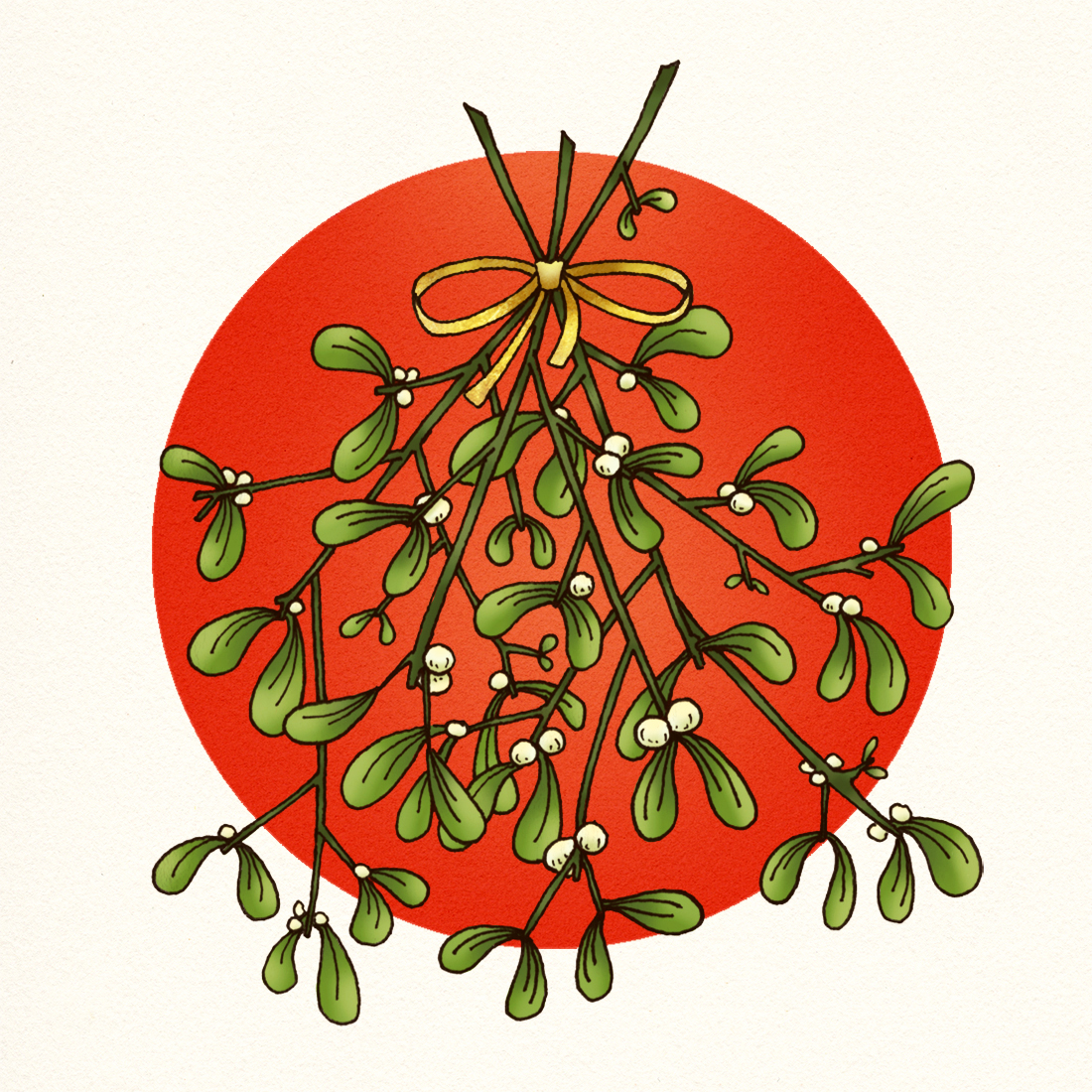
I still use (this photo) to help myself cope with Zoom meetings, though.

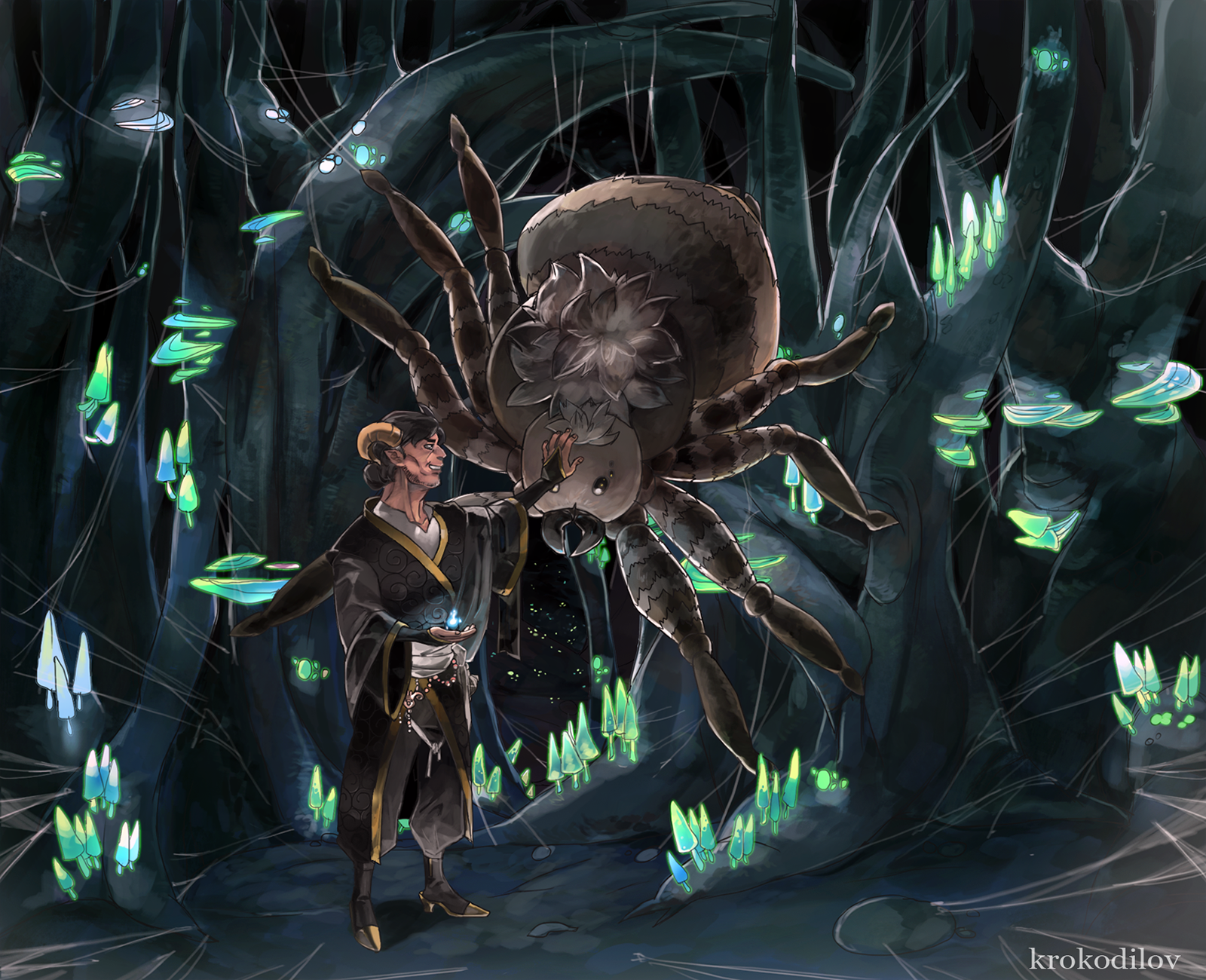
The Demon King, Chapter 7

This illustration is by the brilliant Yura Krokodil (@KrokodilYura on Twitter and @krokodilov on Tumblr). She also posts original comics on DeviantArt (here). This artist is a genius when it comes to environmental painting, and she’s magnificently talented at creature and costume design.

This is a scene from the seventh chapter of The Demon King, in which Balthazar ventures into a creepy mushroom forest and has a meandering conversation with a giant spider named Uniagoliantia. You can read the chapter on AO3 starting (here).

In Return of the King, Frodo and Sam cross through Cirith Ungol (“the pass of the spider”) on their way to Mordor, and along the way they encounter a giant spider named Shelob. The Silmarilion mentions that Shelob’s mother was Ungoliant (“dark spider”), a primordial spirit who took the form of an even larger spider. I think “Ungoliant” is a cool name, but it’s a shame it doesn’t have eight syllables, so I expanded it while making it sound more feminine.

Although there are definitely weird and creepy spiders in the world – just as there are weird and creepy fish and weird and creepy mammals – most spiders are just minding their own business, and I think their big bright eyes and round fuzzy bodies and short little legs are kind of cute.

When it comes to creepy things, I tend to think that mushrooms are much creepier than spiders. Still, they’re very cool-looking. I was talking with the artist about this, and about how the “evil forest” area that always seems to be one of the first dungeons in a lot of RPGs inevitably looks really interesting and beautiful, and she told me that she was inspired by the opening dungeon of Final Fantasy IX, which is called, appropriately enough, Evil Forest. It feels a bit anthropocentric to refer to a place that humans aren’t comfortable as “evil,” and I imagine that the creatures who live in any given “evil forest” are probably quite happy there.

Balthazar from The Demon King

I’m working on creating a character design for Balthazar, the main character of The Demon King.

The visual aspects of his magic are based on the Twilight magic from Twilight Princess, which is a lot of fun to draw. Unfortunately for me, the reader isn’t going to see him casting the magic he specializes in until much later in the story, although other characters will occasionally allude to the fact that he’s able to do something they can’t fully perceive or understand. A large part of the story’s broader narrative arc therefore involves a lead-up to the revelation of what type of magic Balthazar is using, as well as how he’s using it – and why. The Demon King begins as something like a high fantasy sitcom, but (hopefully) it will gradually get deeper into worldbuilding and character backstories as it progresses.

Anyway, I’m still trying to settle on Balthazar’s face model, but I’m moving in the direction of Ranveer Singh, who has interesting and expressive features.

I’m also still trying to figure out his clothing. Specifically, I can’t decide whether his outer robe is the robe of a Roman Catholic priest or a Japanese Buddhist priest, or whether he just threw a blanket over his shoulders.

And please don’t think too hard about how his horns are attached to his head. It’s… magic?

The Sun Also Sets

This is an illustration of Ceres, one of the main characters in an original story I’m working on called The Demon King. (If you’re interested, I’m posting my first draft on AO3, but it’s still very much a work in progress.)

The idea behind this character is that “pure-hearted” video game princesses like Peach and Zelda always seem to rule their kingdoms mainly by themselves, which is a bit disturbing if you think about it. The Demon King has a larger narrative arc, but for now it’s mainly a play on video game tropes, and Ceres is a way for me to explore questions relating to how “legitimate” power and authority are often presented as “feminine” in many fantasy-themed games.

In any case, I’m writing Ceres as a horrible dramatic bitch, and I love her.

Haunted Houses

Earlier this week I published my newest zine of horror-themed microfiction. Haunted Houses contains fifteen very short stories about haunted spaces and the terrible people who inhabit them. The cover art is by @QuinkyDinky, and the zine contains interior art by @irizuarts. I’ve got a listing up on Etsy (here), and I’m also promoting the zine on Twitter (here) and Instagram (here).

This zine is quite short, with each story and illustration occupying only one page. This is partially a trick of formatting, but it’s also a result of careful editing. You wouldn’t want to spend too much time in these places, after all.

I have to admit that, even though I’m categorizing this zine and the two other collections of microfiction that preceded it as “horror,” I’m on the fence about what genre my stories actually belong to.

In my mind, the genre of horror isn’t about a specific set of tropes or narrative structures. Rather, horror is characterized by the psychological and visceral sensation of unease it inspires.

I personally prefer to think of most horror, including the stories I write, as “dark fantasy,” or perhaps simply “magical realism.” I’m not easily creeped out by fiction, mainly because the real world is so lowkey awful so much of the time. As I write this, the National Guard is setting up base at a West Philadelphia Target in advance of the presidential election next week, ostensibly as a “defense” against people engaging in civic protest. There are actual tanks in the parking lot of the place I go to stock up on toilet paper, and that’s really scary. But monsters? Not so much.

I’ve always tended to identify with monsters, and not simply because so many villain characters are overtly coded as queer. Monsters are about disrupting the status quo, and I can get behind that. Postwar American horror cinema, including the slasher films of the 1970s and 1980s, is all about interlopers quietly invading small-town America and infecting people. The story behind many of these movies basically boils down to this: Can you even imagine scary things like communism and feminism and civil rights secretly gaining a foothold in our town? (Stephen King goes into fantastic detail about this in his 1981 book Danse Macabre, if you’re curious, and I think the book still reads well and holds up in many ways.)

To me, monsters aren’t scary because I am the monster, which is an uncomfortable set of life experiences to try to talk about in fiction or otherwise. There’s nothing you can specifically put your finger on regarding why people treat you the way they do, but you know there’s something a little off.

Fuck Sigmund Freud and his weird misogyny and homophobia, but I think I’m on the same page with him regarding “the uncanny” as one of the primary components of horror. Freud got a lot of things wrong in his career, but something he gets absolutely right is that it’s difficult to discuss the uncanny in concrete terms.

The uncanny doesn’t just apply to appearance, of course – social interactions and environments can be uncanny as well. If what I’m writing is horror at all, it probably falls into the subcategory of social horror, which focuses on people behaving in a way that’s almost human, but not quite. Many horror stories are cathartic, in that the status quo is threatened but ultimately restored at the end. Even if things have changed, we can feel relief in the knowledge that at least they’re getting back to normal. With social horror, however, our anxiety is never resolved, because we now understand that the status quo itself is horrifying.

It’s difficult for me to talk about the details of my identity and life in a mimetic way. When I’ve tried, it’s been my experience that people either won’t believe me, will think I’m being manipulative in an attempt to elicit undeserved sympathy, or will be put off by the political elements underlying my descriptions of the ways in which I’ve had to move through the world.

The point of the stories in Haunted Houses is not to try to explain why certain aspects of my life have been unsettling, but rather to create a sense of the uncanny in order to communicate the sense of feeling unsettled for reasons you can’t quite explain. Sometimes my stories about haunted houses are about the hidden trauma of being queer in a society that goes out of its way to create monsters; but, in the end, I just really like telling stories about strange people occupying uncomfortable places. I enjoy exploring these themes both as a reader and as a writer, and I’ve found that summoning the courage to open the door and peer into the darkness on the other side is, if not total escapism, still good spooky fun.

And right now, at this specific moment in time, I think we can all relate to the uncanny experience of feeling trapped in a haunted space, because this is our daily life – we live here now.

Cats Will Kill You

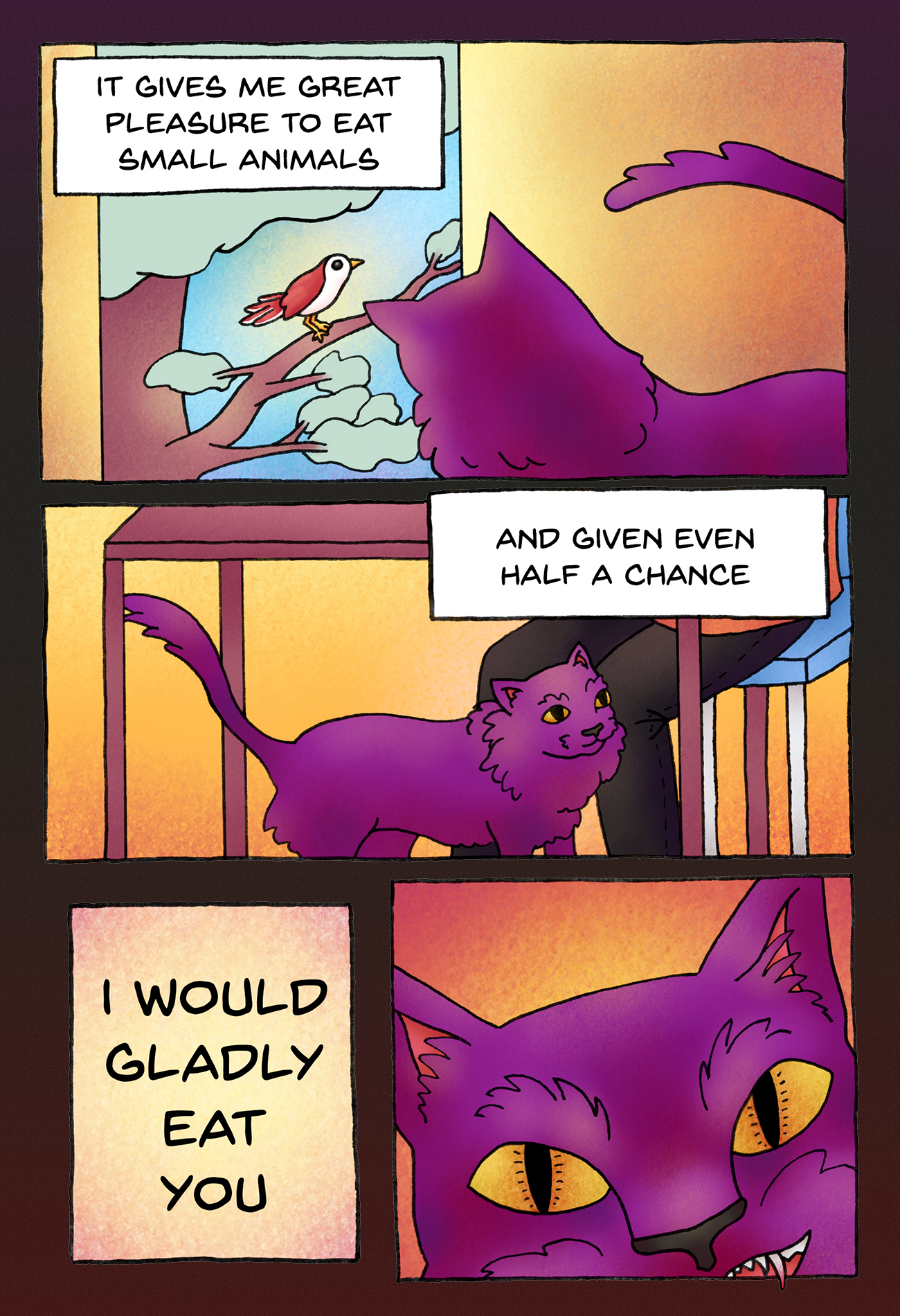
I have nothing but the strongest admiration for everyone who shares their living space with one of these little murder machines.

I drew this comic for the Catsploitation 2 zine created and edited by Matthew Ragsdale (@blankvalleyfilm on Instagram). You can get a copy of the zine from Matthew’s store (here).