Reader of books and player of games. College professor and pokémon trainer. Writes about Japanese fiction, media, gender, and society. In love with monsters and magic.
https://digitalfantasydiary.com/
This is an illustration of Ceres, one of the main characters in an original story I’m working on called The Demon King. (If you’re interested, I’m posting my first draft on AO3, but it’s still very much a work in progress.)
The idea behind this character is that “pure-hearted” video game princesses like Peach and Zelda always seem to rule their kingdoms mainly by themselves, which is a bit disturbing if you think about it. The Demon King has a larger narrative arc, but for now it’s mainly a play on video game tropes, and Ceres is a way for me to explore questions relating to how “legitimate” power and authority are often presented as “feminine” in many fantasy-themed games.
In any case, I’m writing Ceres as a horrible dramatic bitch, and I love her.
The Liar Princess and the Blind Prince is a 2D puzzle platform game about two small children making their way through a creepy murder forest. Unlike similar games (such as Limbo, which jumps immediately to mind), The Liar Princess might best be described as an interactive storybook. The game’s emphasis is not so much on puzzles or platforming, but rather on using the conventions of gaming to help deepen the player’s connection with the characters as they travel through the story together.
This game was created by Nippon Ichi Software, which has developed a reputation for cute horror games with titles like Yomawari: Night Alone and A Rose in the Twilight. Still, I think The Liar Princess isn’t so much horror as it is dark fantasy, or fantasy with a few creepy elements and a touch of dark humor. There’s nothing explicitly violent or disturbing in the story or imagery, and the game itself is quite easy. I probably wouldn’t give this game to a young child, but playing it was a relaxing experience for me as an adult horror fan.
The plot and the gameplay go hand-in-hand, much like the eponymous princess and prince. The story has strong fairy tale elements, with a wolf asking a witch to turn her into a human so that she can save a prince. The prince’s misfortune is the wolf’s own doing, as she accidentally blinded him with her claws. The player’s goal is therefore to help the “princess” escort the prince to the forest witch to be cured before he discovers that she’s the wolf who blinded him. In her beast form, the wolf is powerful and impervious to attack, but she can only hold hands with the prince to guide him forward when she’s in her human form. The wolf can change forms at will, so the main challenge lies in positioning the prince in exactly the right way so that he can walk forward while remaining safe from harm.
The Liar Princess has five levels with four stages each, with a short prologue and a longer “final boss” level. (I’m using scare quotes because this final level is more of an obstacle course than an actual boss fight.) It’s relatively easy to figure out most of the puzzles through trial and error, and the death of either character usually only results in a small setback that generally involves the welcome reset of a specific puzzle. The game also gives the player the option to skip a stage after ten minutes if there’s a puzzle that’s just not clicking. Most of the actual fun of the gameplay involves searching each stage and taking calculated risks to find secret collectibles, which unlock pages of concept art and segments of the forest witch’s backstory. More than anything, The Liar Princess reminds me of the Metroidvania-lite feel of Super Princess Peach in that there’s no real sense of danger and failure is never punished.
The sort of people who complain about games being “too easy,” including no small number of professional reviewers, didn’t hesitate to make that complaint about The Liar Princess when it came out in English translation back in early 2019. The undemanding level of difficulty isn’t a deal-breaker for me personally, but I have to admit that the game isn’t without annoyances. There are a few number puzzles in the third level that are bizarrely tricky, for example, and sometimes it can be hard to tell whether you’re taking the incorrect approach to a puzzle or whether there’s been a glitch in the hitbox for a certain switch that isn’t triggering for some reason.
That being said, the main appeal of this game is visual, with its expressive characters and stylish backgrounds. (In fact, I might even go so far to say that The Liar Princess is perfect for people who love the visual design of Hollow Knight but don’t have the patience to deal with the gameplay.) The character designs are especially interesting and creative, from the weakest enemy in the first stage to the flower-eating “mole” creatures at the end of the game. Although the basic shape outlines are cute and simple, there’s always a fun twist somewhere – when the first mole creature opens its mouth, for instance, you are in for a treat. The game plays with its visual style to make all manner of (relatively gentle) jokes about how the prince doesn’t know that the characters he encounters are all people-eating monsters, and these jokes collectively raise questions about “blindness” and “monstrosity” that are subtle but engaging (and not in the least bit ableist).
My favorite part of the game is the wolf herself, who makes horrible decisions but is basically decent. Despite the fact that she is clearly lying in a way that hurts other people and herself, you can’t help but sympathize with her as her good intentions lead her increasingly astray. The development of the friendship between her and the prince is extremely cute, as is the way both characters smile when they’re holding hands. I’m also a fan of the unapologetically evil witch, and it’s worth seeking out the game’s collectibles in order to learn more about her story.
The Liar Princess and the Blind Prince isn’t a perfect game, and many people will probably think it’s too easy and too short. Playing it from start to finish took me about five hours, including the time I spent going back to earlier stages in order to pick up collectibles I missed and rewatch the cutscenes I unlocked. Despite a few frustrations with the gameplay mechanics, I loved The Liar Princess. I’m somewhat surprised that this game is considered to be a niche title, because it’s refreshingly accessible and a lot of fun. Although the most obvious comparison would seem to be something like Limbo, The Liar Princess actually feels much more like Journey – it’s a visually immersive and relatively chill game about loneliness and companionship that’s easy to dip into for fifteen minutes at a time when you want to relax and unwind.
Earlier this week I published my newest zine of horror-themed microfiction. Haunted Houses contains fifteen very short stories about haunted spaces and the terrible people who inhabit them. The cover art is by @QuinkyDinky, and the zine contains interior art by @irizuarts. I’ve got a listing up on Etsy (here), and I’m also promoting the zine on Twitter (here) and Instagram (here).
This zine is quite short, with each story and illustration occupying only one page. This is partially a trick of formatting, but it’s also a result of careful editing. You wouldn’t want to spend too much time in these places, after all.
I have to admit that, even though I’m categorizing this zine and the two other collections of microfiction that preceded it as “horror,” I’m on the fence about what genre my stories actually belong to.
In my mind, the genre of horror isn’t about a specific set of tropes or narrative structures. Rather, horror is characterized by the psychological and visceral sensation of unease it inspires.
I personally prefer to think of most horror, including the stories I write, as “dark fantasy,” or perhaps simply “magical realism.” I’m not easily creeped out by fiction, mainly because the real world is so lowkey awful so much of the time. As I write this, the National Guard is setting up base at a West Philadelphia Target in advance of the presidential election next week, ostensibly as a “defense” against people engaging in civic protest. There are actual tanks in the parking lot of the place I go to stock up on toilet paper, and that’s really scary. But monsters? Not so much.
I’ve always tended to identify with monsters, and not simply because so many villain characters are overtly coded as queer. Monsters are about disrupting the status quo, and I can get behind that. Postwar American horror cinema, including the slasher films of the 1970s and 1980s, is all about interlopers quietly invading small-town America and infecting people. The story behind many of these movies basically boils down to this: Can you even imagine scary things like communism and feminism and civil rights secretly gaining a foothold in our town? (Stephen King goes into fantastic detail about this in his 1981 book Danse Macabre, if you’re curious, and I think the book still reads well and holds up in many ways.)
To me, monsters aren’t scary because I am the monster, which is an uncomfortable set of life experiences to try to talk about in fiction or otherwise. There’s nothing you can specifically put your finger on regarding why people treat you the way they do, but you know there’s something a little off.
Fuck Sigmund Freud and his weird misogyny and homophobia, but I think I’m on the same page with him regarding “the uncanny” as one of the primary components of horror. Freud got a lot of things wrong in his career, but something he gets absolutely right is that it’s difficult to discuss the uncanny in concrete terms.
The uncanny doesn’t just apply to appearance, of course – social interactions and environments can be uncanny as well. If what I’m writing is horror at all, it probably falls into the subcategory of social horror, which focuses on people behaving in a way that’s almost human, but not quite. Many horror stories are cathartic, in that the status quo is threatened but ultimately restored at the end. Even if things have changed, we can feel relief in the knowledge that at least they’re getting back to normal. With social horror, however, our anxiety is never resolved, because we now understand that the status quo itself is horrifying.
It’s difficult for me to talk about the details of my identity and life in a mimetic way. When I’ve tried, it’s been my experience that people either won’t believe me, will think I’m being manipulative in an attempt to elicit undeserved sympathy, or will be put off by the political elements underlying my descriptions of the ways in which I’ve had to move through the world.
The point of the stories in Haunted Houses is not to try to explain why certain aspects of my life have been unsettling, but rather to create a sense of the uncanny in order to communicate the sense of feeling unsettled for reasons you can’t quite explain. Sometimes my stories about haunted houses are about the hidden trauma of being queer in a society that goes out of its way to create monsters; but, in the end, I just really like telling stories about strange people occupying uncomfortable places. I enjoy exploring these themes both as a reader and as a writer, and I’ve found that summoning the courage to open the door and peer into the darkness on the other side is, if not total escapism, still good spooky fun.
And right now, at this specific moment in time, I think we can all relate to the uncanny experience of feeling trapped in a haunted space, because this is our daily life – we live here now.
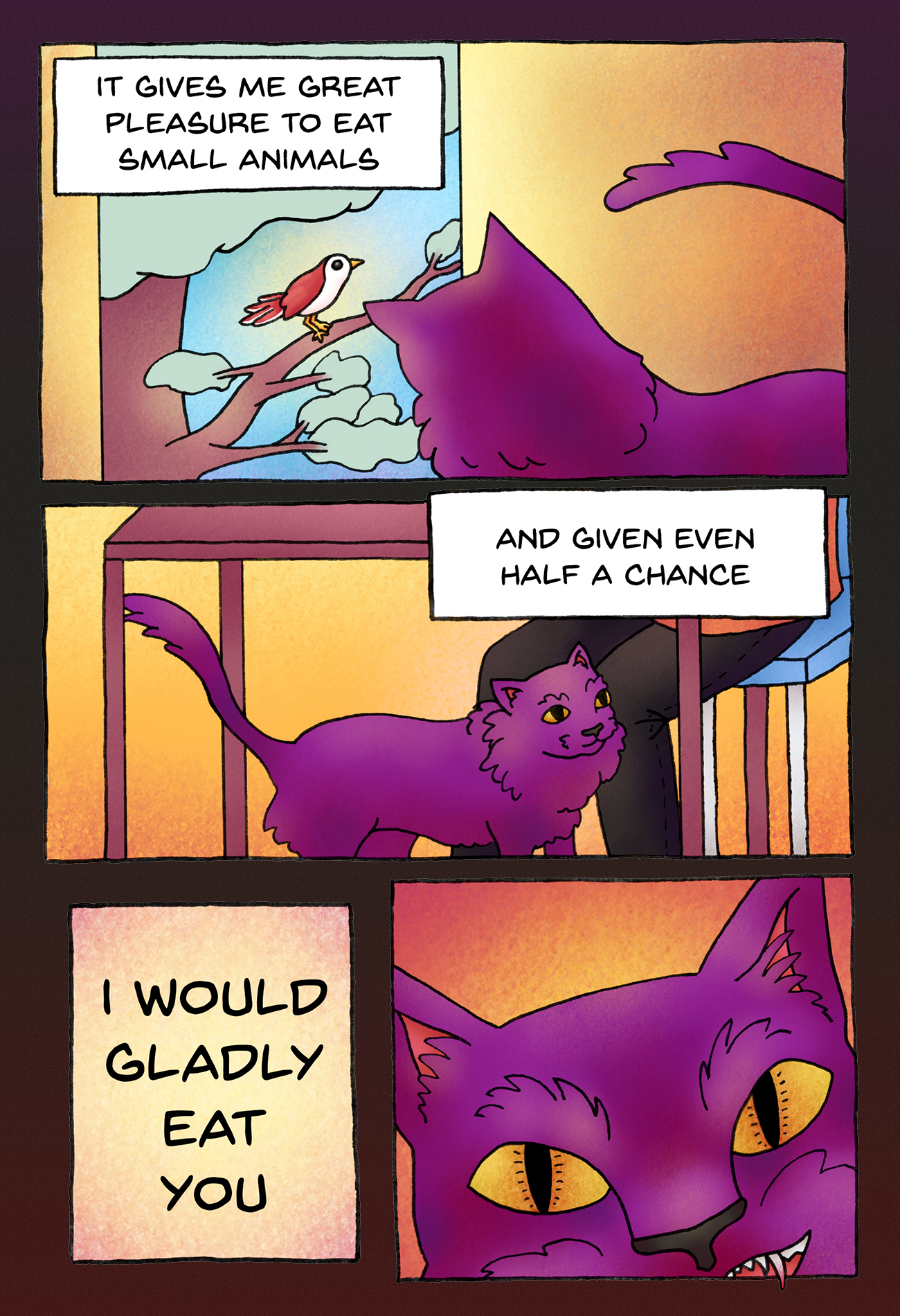
I have nothing but the strongest admiration for everyone who shares their living space with one of these little murder machines.
I drew this comic for the Catsploitation 2 zine created and edited by Matthew Ragsdale (@blankvalleyfilm on Instagram). You can get a copy of the zine from Matthew’s store (here).
A conversation with a friend reminded me that “self-care” means actually taking care of yourself at work. “Working through the pain” is sometimes necessary in special circumstances, but it shouldn’t be expected, and it definitely shouldn’t be the default.
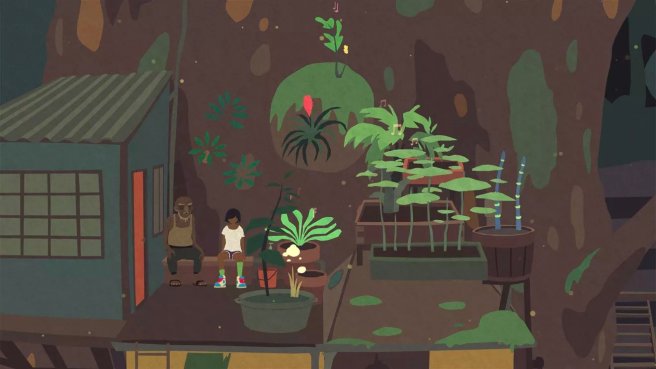
The Last Campfire is a puzzle-centric exploration game with no combat or danger that should take most players between three to five hours to finish.
If we can posit that there are three main genres of video games – shooting, it’s about depression, and Nintendo – The Last Campfire is definitely about depression. You play as a childlike little creature called an “ember” (who are like the red-robed creatures in Journey, but baby) that is either dying or already dead, and your goal is to move on to the afterlife. Along the way, you’re tasked with helping other embers that have gotten psychologically stuck and are unable to complete the journey on their own.
There are four main areas of the game – forest, swamp, marsh, and cave – and you have to help four embers from each area before you can progress to the next. To help an ember, you must first locate it in the overworld before entering its inner world, which consists of a single puzzle or short series of puzzles, all of which are spatial in nature and generally involve moving blocks or floor tiles. None of the puzzles are timed or involve physical dexterity, and you can reset each puzzle by leaving the headspace of the ember and returning. There’s no penalty for this, and loading times are super short, thankfully.
The game has an easy mode that simplifies the puzzles, but all of the puzzles are already so simple and self-explanatory (even for a dumb-dumb like myself) that this isn’t necessary. In fact, I’m going to say that playing on easy mode might actually be more difficult, as it removes some of the discrete steps intended to teach you how the game wants you to solve each puzzle. Either way, nothing important is actively hidden from the player, so you can solve most puzzles just by fooling around with them for long enough.
The difficult thing about The Last Campfire is locating the lost embers in the first place. Like a Zelda game, the overworld has its own share of puzzles, and it’s rarely self-evident where you’re supposed to go. There is zero signposting, and all of the screens that comprise an area have multiple entrances and exits (some of which are one-way), meaning that it’s easy to get lost. It’s also not immediately clear what you can and can’t interact with, and I have to admit that I had to consult a walkthrough very early on to learn that the player is expected to find and physically touch the ossified bodies of the lost embers in order to solve their puzzles and progress through the game.
Unlike the individual ember puzzles, it’s easy to get stuck in the overworld and not know what the game wants you to do. Although it’s fun to explore the beautiful environments, I think The Last Campfire would have greatly benefited from some sort of map. For me, this was the difference between the game taking three hours (which I think is supposed to be an optimal playtime) and taking almost six hours, which I mainly spent getting lost and having to consult various YouTube videos to figure out where I was supposed to go and what specific object I was supposed to interact with.
I think that the game could also have benefited from giving you the option to turn off the voice acting. The English version of the game is narrated by a woman with the exact accent and vocal pitch and timbre of Björk. While this narration was cool at first, it gradually began to grate on me, especially when I would get frustrated. The actress sometimes puts a heavy “w” sound in some of her lines (as in, “the ember had mispwaced a memowy”), which can get a little too close to Elmer Fudd territory if you’re listening to the same line being repeated for the fifth time while re-entering an area or restarting a puzzle.
(I should say that I don’t mean to hate on Icelandic accents, which are lovely. Still, I think creating a Pavlovian association between frustration and someone’s voice has the potential to generate annoyance at anyone’s accent and vocal patterns.)
The Last Campfire isn’t as chill and relaxing as it seems to want to be, and most people are probably going to have to play it at least partially with a walkthrough; not because it’s actually difficult, but rather because of what I think it’s fair to call a certain immaturity of game design. Still, it’s an interesting little game, especially during the periods when it’s better about subtly guiding the player forward.
In a lot of ways, The Last Campfire reminds me of a 1992 Super Nintendo game called Soul Blazer, which was a very simple and sweet game about freeing the souls of a cursed world’s inhabitants by entering the dungeonlike spaces of their minds. It’s a neat concept, especially in the visual contrast both games display between the lush natural spaces of the outer world and the barren and overly complicated spaces of the inner worlds of individual minds. I also appreciate that both games acknowledge and respect the fact that not everyone wants to be “saved” by a hero. As one ember in The Last Campfire puts it: Not every problem is a puzzle to be solved.
More than anything, it’s the visual landscape of The Last Campfire that appealed to me, especially in combination with the atmospheric ambient music and the crisp sound design. I think that, if you enjoy this sort of game, the merits of The Last Campfire outweigh its flaws. I also think it has a decent replay value, if only in the sense that it may be more enjoyable to play for the second time once you know where everything is and what you’re supposed to do.
Almost everyone who’s written about The Last Campfire has mentioned encountering a few glitches and frame rate issues. I played the game on the Nintendo Switch Lite and had no problems with that sort of thing at all. The game can easily be divided into short sessions (and its autosave feature is completely unobtrusive and stress-free), so I think it may be better suited to a small-screen portable experience.
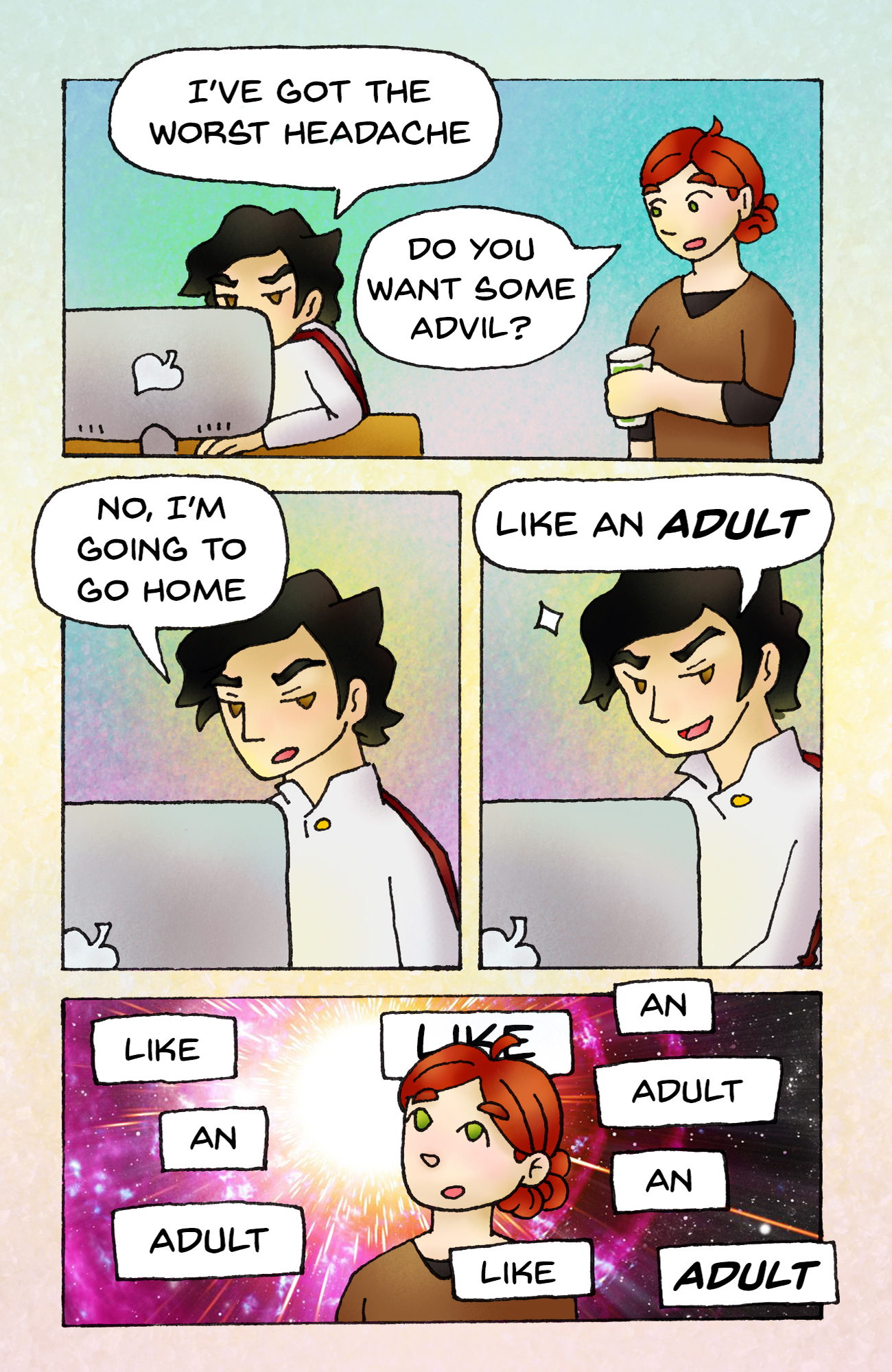
I made this comic to psyche myself up to apply to a fandom zine I was 99% sure would reject me.
They did in fact reject me, but I’m glad I applied. While I was putting together a portfolio to submit to them, I realized just how far I’ve come with visual art, and this filled me with determination to keep improving.
I should acknowledge that this piece is also a study in paneling based on a page of Aliza Layne‘s fantastic graphic novel Beetle & the Hollowbones, which I can’t recommend highly enough. I worked with Aliza to create a short comic awhile back, and it was an incredibly inspiring experience!