The Girl in the Screen at the End of the World

It’s been more than twenty years since rumors about a cursed videotape began to spread. The stories were true, and Japan is in ruins. Can the people who survived the collapse of civilization escape Sadako’s curse? Or do they seek her out instead?

“The Girl in the Screen at the End of the World” is a series of four short vignettes about the last living humans making their peace with the end of the world as Sadako bids a gentle goodbye to modern civilization. All of the human characters in the story die, but all the animals go on to live their best lives.

The story is complete at 1,800 words, and it’s on AO3 here:
https://archiveofourown.org/works/47735320

I had the immense privilege of working with an artist who goes by Vani on an illustration for this story. I was inspired by his short Animal Crossing comic about grief (here), and I love the way he draws handsomely rendered characters in lush environments brought to life by bold colors. You can find more of his evocative art on Twitter (here), on Instagram (here), and on Tumblr (here).

The Suicide of Rachel Foster

The Suicide of Rachel Foster is a suspense thriller in the form of a walking sim that takes about three hours to play. The game has moderate elements of horror, and the relationship between the player-character’s father and the teenage girl he groomed is a key part of the story.

This is a difficult game to recommend, as I’m not sure its merits outweigh its flaws. These flaws aren’t necessarily related to the story, which is engaging despite its sensitive themes. Rather, The Suicide of Rachel Foster has major gameplay issues that will probably be a turn-off for anyone who isn’t already a veteran fan of walking sims. In other words, The Suicide of Rachel Foster is a very walking-simy walking sim, and I think it’s safe to say that people who aren’t interested in the premise probably won’t get a lot out of the game.

That being said, the premise is a banger: Your dad was the manager of what is essentially the Overlook Hotel from The Shining, and you get trapped in the hotel by a snowstorm while inspecting the property after your dad’s death. As you poke around mementos of the past, a terrible family secret comes to light, and it’s entirely possible that you’re not as alone in the building as you were led to believe.

The Suicide of Rachel Foster begins when the player character, Nicole, gets a letter from her late mother, who hired a lawyer to deliver the document to her on the event of her father’s death. Ten years ago, when Nicole was 16, her mother took her to Portland when she left her father and the hotel in Montana they managed together. Nicole’s father had been pursuing an affair with one of Nicole’s classmates, the eponymous Rachel Foster. Rachel became pregnant and committed suicide by jumping off a cliff in the mountains.

The Timberline Hotel struggled on for another six years but closed in 1989, and Nicole’s father continued to live there for another four years before committing suicide himself. It’s now 1993, but everything in the hotel is more or less how it was when Nicole left in 1983 – including, creepily enough, her childhood bedroom. Regardless, the elements have taken their toll on the building, and Nicole is legally required to perform an in-person inspection before she has her father’s lawyer sell the property to a hotel chain.

Thankfully, the hotel still has hot water and electricity. Nicole is connected via a very chunky cellphone to a man named Irving, who identifies himself as a FEMA agent who’s been assigned to monitor her situation. Irving cautions Nicole not to leave during the snowstorm, and he helps guide her through the hotel so that she can keep the lights on and the water running during the emergency.

Oddly enough, Irving seems a little too helpful, and maybe just a little too available. He explains that he’s been a member of the small-town community since he was a child, but perhaps he knows a bit too much about the history of her family. Nicole is suspicious of Irving at first; but, the longer she’s stuck in the hotel, the more she comes to trust him. Despite Irving’s misgivings, Nicole starts to investigate the death of Rachel Foster, and she begins to suspect that perhaps the girl didn’t commit suicide after all.

While Nicole is stuck in the hotel for nine days, the player is tasked with finding the answers to three questions. What happened to Rachel ten years ago? What does Irving know that he isn’t telling you? And something is clearly strange about the hotel – what’s going on there?

While The Suicide of Rachel Foster presents an intriguing set of intertwined mysteries, the performance of Nicole’s voice actress rubbed me the wrong way. Nicole comes off like a whisky-slinging, battle-hardened intergalactic bounty hunter, which is an odd approach to the character. Nicole is only 26 years old, and she’s something of a blank slate. She doesn’t seem to have a job, or friends, or interests, or hobbies, or even practical knowledge concerning how to maintain the hotel. To me, it didn’t feel like Nicole’s badass attitude is earned, and it grated on my nerves.

In addition, one of the main thematic questions of the game doesn’t mean anything to me. Can you still love your dead father if he abused your mother, seduced and impregnated your teenage friend, and then didn’t contact you for ten years? Like… no?? At the very least, this is a complicated issue that would have required much more heavy lifting than the game’s script was willing to do.

Thankfully, what’s going on with Irving is far more interesting, and his voice actor gives an incredible performance that made me feel way more sympathy toward his character than perhaps I should have.

In any case, the game is primarily concerned with creating an atmosphere of slowly mounting dread.

Unfortunately, Nicole walks at a glacial pace, which makes it a pain to explore the hotel. The map you’re given isn’t terribly useful when you have it, and Nicole loses it halfway through the game. The location of your objectives isn’t clear, and there’s a lot of extraneous space with no plot relevance. It’s easy to get lost, and there are no nudges to help get you back on the critical path.

Because you move so incredibly slowly, I ultimately gave up on free exploration and used a walkthrough, this one (here). There’s nothing wrong with using a walkthrough, of course, but I wish it weren’t necessary.

I should note that you can run, but this is also a pain. To run in the Nintendo Switch version of the game, you have to exert force to press down the left joystick as you move it. This is extremely awkward and uncomfortable. To put it bluntly, it’s an obvious accessibility issue that doesn’t need to exist.

Also, you’re occasionally given dialog choices that don’t make much sense. You’ll choose one thing, and then Nicole will say something else. These choices are timed for some inexplicable reason, and what you say doesn’t have any impact on the plot.

This makes it all the more confusing when you’re given a choice that does matter at the end of the game, which is whether or not to allow Nicole to commit suicide. This is a weird choice to have, to be honest, especially since there’s nothing about Nicole that indicates she’s depressed or suicidal. Again, the player doesn’t know anything about her, and nothing that happened in the past is her fault. Even if you don’t allow her to commit suicide, I don’t understand the “good” ending, which doesn’t make any logical or emotional sense.

I know this seems like a lot of criticism, but it’s worth repeating that the game isn’t that long, and its main focus is on creating a creepy narrative atmosphere to accompany its lovingly rendered spatial environment. You can probably finish the story in two and a half hours if you use a walkthrough from the beginning and don’t get stupidly lost like I did, and the gameplay issues might not bother someone more inured to the idiosyncrasies of walking sims.

I have to admit that I never really warmed up to Nicole or felt any sympathy for her sexpest father, but Irving grew on me. The intertwined stories of what happened to Rachel Foster and what’s currently going on in the hotel are extremely intriguing, as is the physical environment of the hotel itself.

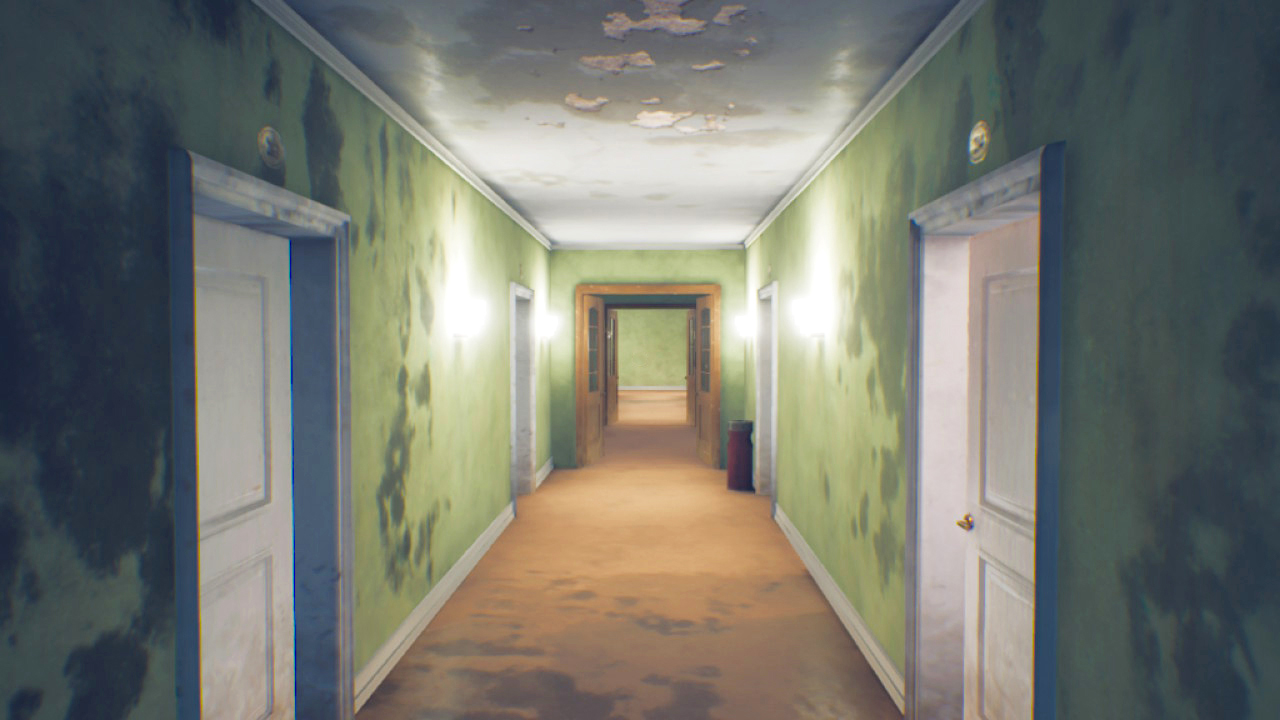
I’m a huge fan of The Shining, both the Stephen King novel and the Stanley Kubrick film, and it was cool to see what the “staff only” spaces of a place like the Overlook might actually look like, from the caretaker apartments to the boiler room to the industrial kitchen freezer to the utility crawlspaces. Mercifully, there are no elevators in the Timberline Hotel, but the carpeted hallways are plenty spooky enough. There’s also a secret underground passage with a secret room. I consider myself to be a connoisseur of secret basement rooms, and this one gave me serious chills.

If you’re not sold on The Suicide of Rachel Foster but curious about where it goes with its premise, I’d recommend checking out the Wikipedia article (here), which contains a detailed plot synopsis. I think The Suicide of Rachel Foster probably would have made a better novel, but there’s also something to be said for the experience of being able to walk through the hotel while hearing every creak of the floorboards and every rattle of the pipes in the walls. If nothing else, the sound design is amazing, and the dev team clearly put a lot of love and care into creating an immersive setting.

So, in conclusion, while The Suicide of Rachel Foster is a difficult game to recommend to everyone, I personally very much enjoyed being drawn into the strange and horrible story of the Timberline Hotel.

Hyrule’s Finest Teas

Link is a second-year college student who works as a barista at a small café on a cobblestone street next to his university. Every day he waters the plants, samples new teas, and listens patiently to the concerns of the people who visit. He especially enjoys the company of one of the regulars, a posh upperclassman named Zelda who comes to the café every day to write. It would be the perfect job if not for his boss, whose excellent taste does little to blunt the edge of his exacting standards.

It took me years of being in fandom to reach this point, but I finally embraced the cliché of writing a Coffeeshop AU. I had an intense Fall 2022 semester, and I wrote “Hyrule’s Finest Teas and Imports” to let off steam during the winter break. This started as a wholesome story about delicious café food, but it gradually transformed into something a bit darker. While I was thinking about why someone like Ganondorf would manage a café, I did a lot of research into the shady real estate practices common around college campuses in the United States. I ultimately decided that it would be fun for Ganondorf to commit tax fraud. As a treat.

The story is complete at four chapters and 9,200 words. It’s on AO3 here:
https://archiveofourown.org/works/43918116/chapters/110424639

I was extremely fortunate to work with the magical Mirarasol on an illustration for this story. Mirarasol creates lovely artwork of cute characters inhabiting stylish interiors, and they’ve done fan art for a number of games in addition to their original illustrations. If you’re interested, you can check out their work on Twitter (here) and on Instagram (here).  

WWAC Roundtable on LGBTQ+ Manga

Last week I had the opportunity to contribute to a Pride Month roundtable on LGBTQ+ manga organized by Women Write About Comics. In this roundtable, we share specific recommendations as well as more general thoughts on topics such as autobiographical essay manga, nonbinary manga characters, and debates surrounding BL and yuri manga.

The discussion was quite interesting, and you can read it here:
https://womenwriteaboutcomics.com/2023/06/roundtable-pride-month-manga-edition/

This conversation was very cathartic for me personally. It was a traumatic experience to publish my monograph on queer manga, as I encountered incredible resistance during every step of the project. I’ve also been surprised by the feedback I’ve received, with critics claiming that I didn’t write enough about “real” queer creators. My book feels more cursed than the Necronomicon, and I’ve been extremely hesitant to talk about it or the research that went into it. Still, it felt good to finally address the issue of who “gets to count” as queer, as well as why many queer people in Japan may not have chosen to identify as such in the past.

Thankfully, the situation in Japan is starting to change, and WWAC’s Pride Month manga roundtable captures the spirit of this social and cultural shift as it’s reflected in popular discourse, especially in creative work by and about openly queer people exploring and celebrating their identities.

Varré’s Bouquet

Deep under the Royal Capital of Leyndell, the cursed Omen son of Queen Marika bides his time within a prison of shadows. When the ambitious young surgeon Varré is summoned to attend to Mohg’s crown of horns, the two men forge a close bond, yet Varré can do nothing as the shining prince Miquella tempts Mohg with tales of a frightful power hidden within the dark hollows of the earth. As the Lands Between fall to ruin, Varré realizes the wisdom of Miquella’s dream, and he once again offers himself to Mohg, along with his love – and his blood.

While sweating through a set of analytical essays and academic book reviews earlier this year, I amused myself by writing a short story about the two worst characters in Elden Ring, White Mask Varré and Luminary Mohg. They’re both terrible people, but I’m intrigued by the unwritten backstory of their relationship. Because Varré is so unapologetically supportive of Mohg’s evil schemes, the pair has become the subject of a number of silly tongue-in-cheek memes (this one on Tumblr is probably of my favorite), but I followed my heart and wrote unironic gay monster romance. Game Rant may have called Mohg the “worst LGBT+ representation,” but I think he and Varré are adorable.

My story is complete at 3,800 words, and you can read it on AO3 here:
https://archiveofourown.org/works/46268107/chapters/116484187

I consider myself extremely lucky to have been able to work with Paristandard to create an illustration for the story. Along with Elden Ring, they also draw fan art for Lord of the Rings and The Silmarillion, and their original comics and character designs are fantastic. You can find their work on Twitter (here) and on Instagram (here).

Paranormasight: The Seven Mysteries of Honjo

Paranormasight: The Seven Mysteries of Honjo is a supernatural thriller set in the Honjo neighborhood of Sumida Ward in central Tokyo during the 1980s. This visual novel’s story is told via the intersecting perspectives of three main protagonists through a series of short episodes laid out along a story grid. Although you have some choice regarding the order in which you play the episodes, the story is linear, with minor branching paths leading to premature endings. Paranormasight has strong elements of horror, as well as a few jumpscares, but it’s sensitive about its use of mature themes and graphic visual imagery. Depending on how quickly you read, it should take about ten to twelve hours to unlock all of the endings.

Let me cut to the chase: I really enjoyed Paranormasight and would happily recommend it even to people who aren’t horror fans. The game only has a moderate level of interactivity, so I’m not sure it would appeal to people who dislike visual novels. That being said, Paranormasight is at the height of its genre, and it’s as well-written, well-illustrated, and intriguingly presented as a visual novel can get.

A quick description of the story is going to sound like anime nonsense, but please take my word for it that this is a story written for an adult audience and bear with me for a moment.

During the early modern Edo period, an onmyōji wizard found the secret to a ritual that would bring someone back from the dead. In order to recreate the soul of the deceased, one would need to store sufficient “soul dregs” of murder victims inside a ritual object. The wizard managed to perform the ritual, a process that resulted in nine deaths. The history of these deaths has survived to the present in the form of urban legends about the “seven mysteries of Honjo.”

Late one night, ritual objects in the form of wooden netsuke charms mysteriously appear in the hands of nine people in the Honjo neighborhood. In addition to the physical charms, these “curse bearers” have inherited the resentful memories of the victims of the original ritual, as well as the power to kill others with a curse, which they’re able to trigger when certain conditions are met. If one of the curse bearers manages to kill enough people, they’ll be able to perform the ritual of resurrection – but only if another curse bearer doesn’t kill them first.

Paranormasight opens with a stand-alone prologue in which one of the curse bearers meets a gruesome end. When the prologue is concluded, the story is taken up by three more curse bearers: a grieving mother whose young son died in a kidnapping incident, a high school girl whose best friend committed suicide, and a senior police detective assigned to investigate the mysterious death of a youth truancy officer. All three of these protagonists are sympathetic, as is the companion character accompanying each of them. As the story unfolds, they gradually begin to work together in an attempt to figure out what’s happening so that they can survive the curse while preventing more murders.

I feel like I’ve spent years quietly waiting for Square Enix to start publishing visual novels, and I’m happy it’s finally happening. Visual novels are somewhat infamous for being relatively inexpensive to make, and it’s so cool to see one of these games with big-budget production values. Although the art and music are wonderful, the high quality of Paranormasight mainly comes through in the strength of its writing, its manga-style mise-en-scène, and its excellent translation.  

When I talk about the mise-en-scène, I’m referring to the cinematic framing of each scene. While many visual novels will show you a visually flat illustration of a character superimposed on top of a static background, Paranormasight puts a great deal of effort into making conversations feel more dynamic, with the camera following standard “line of sight” rules to show the player the conversation from different angles and perspectives. As a result, Paranormasight feels like reading a manga instead of reading an illustrated novel. This framing isn’t overly dramatic and doesn’t draw attention to itself, but it must have required an incredible amount of planning and effort to pull off with such skill and variety.

The same goes for the writing. The writing doesn’t go out of its way to appear “brilliant,” but the way the various threads of the characters gradually become woven into the larger story is incredible. Although you’ll often have to finish one character’s current storyline before continuing another’s, I was impressed by how the game maintains its forward momentum while still giving the player a fair amount of freedom to move between characters and conversation topics. I also appreciate how none of the characters ever devolves into a stereotype, and how both major and minor characters have a balanced mixture of admirable and problematic personality traits.

On a lark, I downloaded Paranormasight onto my older Nintendo Switch and played the prologue in Japanese. I can therefore say with confidence that the English translation is excellent. The translation team preserves the flavor of the original writing through canny localization choices, especially regarding the game’s more arcane vocabulary. I’ve been annoyed with the translation of Tears of the Kingdom, which is filled with nonsense like “Ultrahand” and “secret stones,” so I admire how the English version of Paranormasight manages to make its more unusual terms seem perfectly natural.  

Despite its goofy name and slightly silly supernatural premise, Paranormasight was created for an audience of intelligent adults. The game is very much mass-market entertainment published by a giant corporation, so perhaps it’s not as bold or edgy as it could be, but I actually think this market concession to “broad appeal” is a blessing. Sometimes it’s nice to read a horror thriller that has the confidence not to rely on sexual assault, fantastically grotesque violence, or poorly-disguised bigotry against minorities. As a fun bonus, there are no creepy “male gaze” character designs, just a wide range of character types who are drawn in an appealing anime-influenced style but still look like real people.

Paranormasight was developed in cooperation with the Sumida City Tourism Association, and the game does a fantastic job of giving the player a sense of its setting. This works especially well in tandem with the story’s theme of how many Japanese urban legends are closely connected to a specific place and the history of the people who live there. Although most of the gameplay involves choosing how to advance the conversation, there are also moments when the player is invited to explore an area via a visual panorama while investigating points that catch their attention. It’s fun to explore this weird little neighborhood in Sumida that’s been around since the Edo period, and you never feel as though you’re on the receiving end of a history lecture.

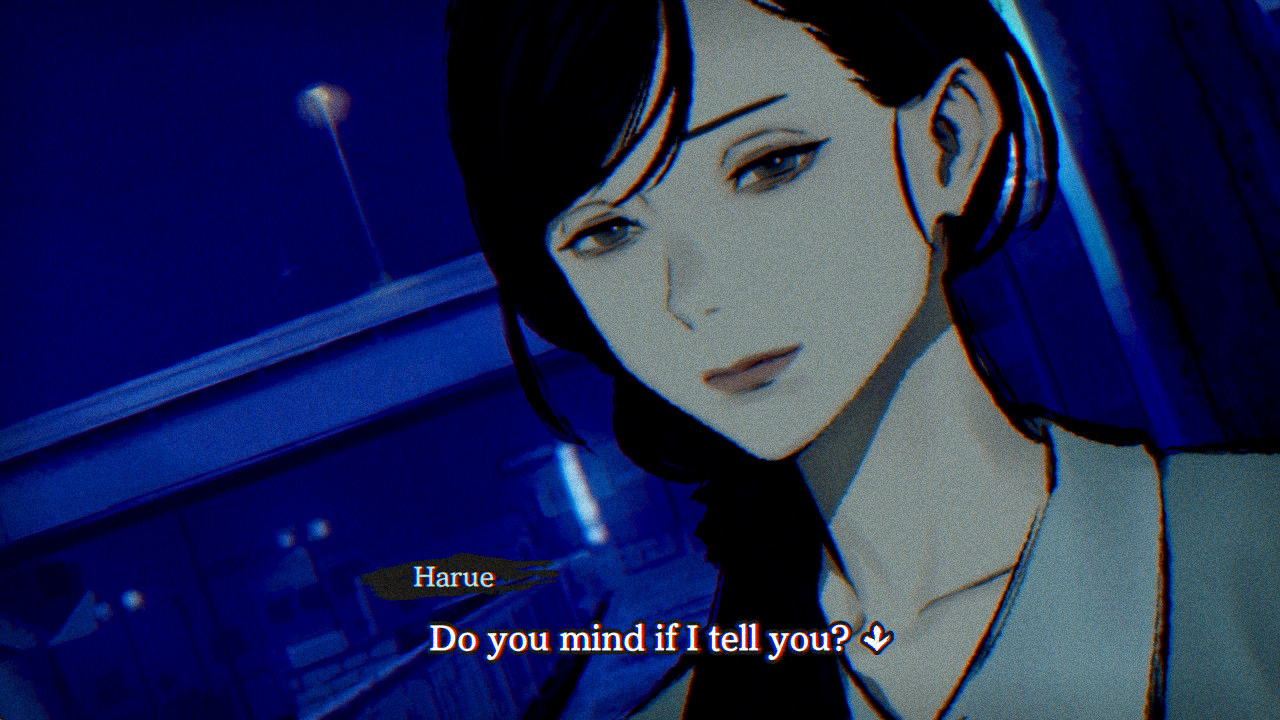
One of the coolest aspects of Paranormasight is its framing device, in which a narrator wearing an Edo-period kimono and a half-face Noh mask directly addresses the player. This narrator invites the player to watch the story through a Shōwa-era color television, one of the bulky cathode-ray screens embedded in its own piece of furniture.

The menu has a great time with this retro aesthetic, distorting the background with tv “noise” and curving the screen at the edges. From the menu, you can access an annotated index with entries for the characters, places, and historical incidents that appear in the story. Each entry is accompanied by an illustration and two or three paragraphs of text. I generally don’t bother with the annotated indices in visual novels, but the one in Paranormasight is especially well-written and edited to provide a satisfying amount of intriguing information without overwhelming the player with walls of text. I also love that the entries for the urban legends are illustrated with period-accurate woodblock prints.

For someone with my particular set of interests, Paranormasight is a 10/10 game. Even if you’re not into urban history or urban legends, I still think the strength of the game’s writing and the cleverness of its design are strong selling points. You can download Paranormasight as a phone app, but it’s perfect for Nintendo Switch’s handheld mode and well worth the $20.

By the way, if you’re intrigued by the concept of “virtual tourism through a visual novel,” I’d also like to recommend the supernatural mystery thriller Root Letter. Its story is set in the small city of Matsue in rural Shimane prefecture, which is also famous for its Edo-period urban legends. Root Letter is very good, but it’s nowhere near as polished as Paranormasight. Square Enix really hit it out of the park with this one.

Fishing Vacation Review on Sidequest

I’m excited to have published my first video game review for Sidequest! I had the opportunity to write about Fishing Vacation, a Game Boy horror adventure game from 2020 that was released for Nintendo Switch at the beginning of June. Here’s an excerpt from my review…

What intrigued me about Fishing Vacation wasn’t necessarily its atmosphere of creeping horror, but rather how its story provides a critical perspective on the fantasy of “getting away from everything to live in nature.” During the prologue, your friend jokes about having quit his job, but there’s a sense of unease to his cheerfulness that’s later reflected in his nightmares. I imagine that many people harassed by the pressures of a prolonged economic recession have experienced similar anxieties, and perhaps many of us have entertained a similar fantasy of dropping everything to disappear into the woods. Fishing Vacation forces the player to confront the unpleasant consequences of cutting oneself off from society.

You can read the full review on the Sidequest website here:
https://sidequest.zone/2023/06/19/review-fishing-vacation-dredges-up-unwholesome-summer-fun/

Haunted Houses

I recently published a new edition of my horror fiction zine Haunted Houses!

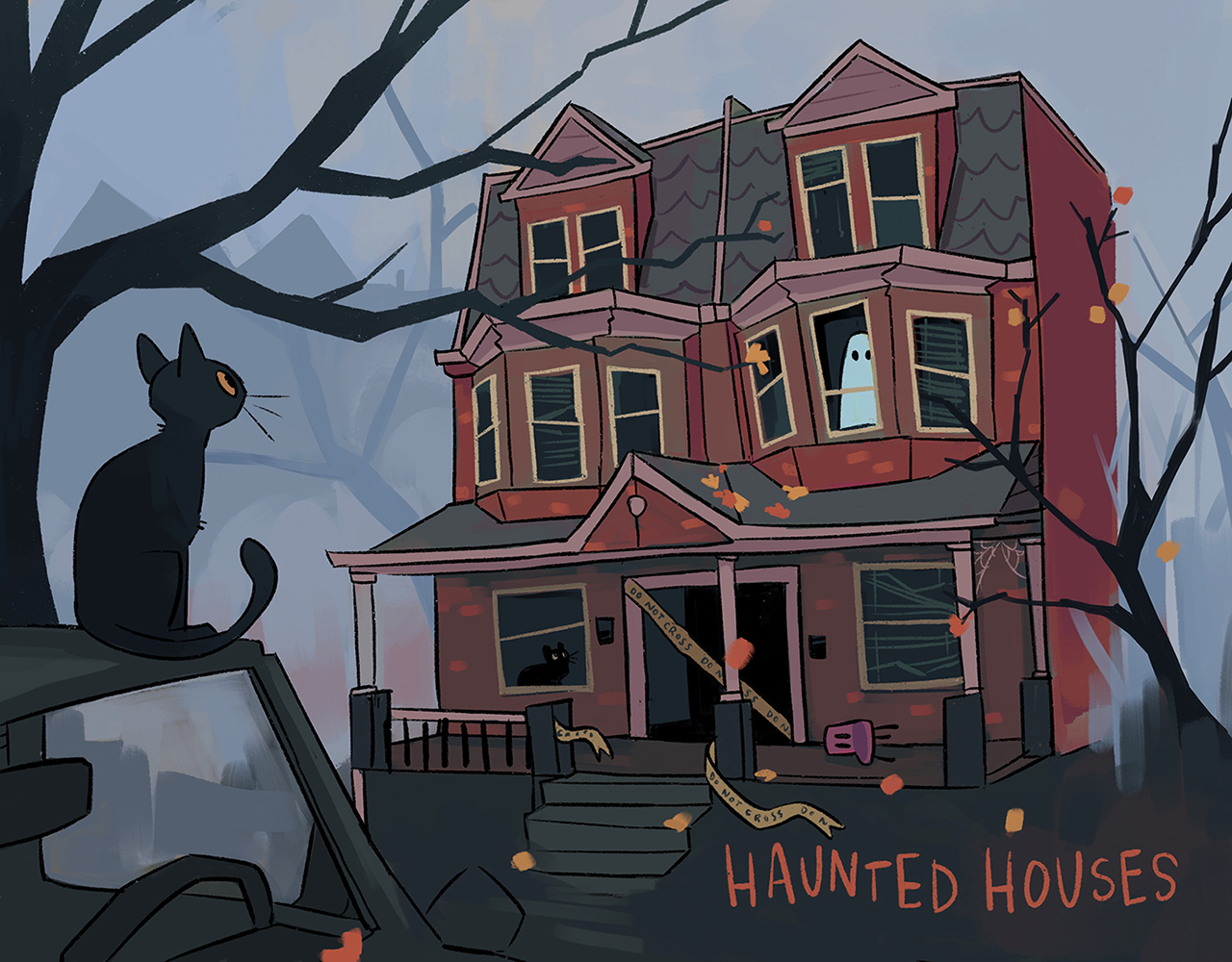
Haunted Houses collects seventeen pieces of surreal flash fiction about haunted spaces and the terrible people who inhabit them. This edition of the zine includes several new stories and illustrations, as well as a gorgeous cover illustration by Megan Crow, who was able to channel the everyday spookiness of West Philadelphia. Although the stories in this zine fit firmly into the mode of magical realism, I wanted to use the medium of fiction to explore a truly terrifying set of real-life themes relating to housing, from gentrification to rent spikes to urban depopulation.

If you’re interested, physical copies of the zine are available on Etsy:
https://www.etsy.com/listing/890744799/haunted-houses-fiction-zine

I’ve also started to host free digital editions of my older zines on Itchio:
https://digitalterrarium.itch.io/

The Witch’s House

The Witch’s House is an RPG Maker gothic horror game from 2012 that was released as a remastered edition for Nintendo Switch in October 2022. The game consists of cute environmental puzzles presented in gorgeous 16-bit pixel graphics, and it’s brutally violent in an over-the-top and almost cartoonish way. It takes about fifty minutes to play if you’re good at video game puzzles, and maybe an hour and twenty minutes if you need to consult a guide like I did.

You play as Viola, a 13yo girl who finds herself alone in the woods outside a mysterious mansion. A black cat greets her and invites her to wait inside until her father comes to pick her up, thereby trapping her within a hungry and malicious labyrinth. Your job is to find a way to escape the house while learning the story of the girl who lives there, a young witch named Ellen.

The game drops you right into the action with very little preamble. Within sixty seconds, you’re inside the house. Within another sixty seconds, you’ve probably already died for the first time. I was shocked and delighted by how graphic this first death was. Viola’s deaths become more horrendous and creative as you get deeper into the house, and the main appeal of the game is seeing all the fun ways this cute anime girl can die.   

With one or two exceptions, surviving the traps isn’t a matter of reflexes. Instead, the game asks you to solve simple puzzles by interacting with the environment. The house is divided into five floors, and each floor is further divided into discrete suites of rooms associated with a specific puzzle sequence. Only the fifth and final floor has enough moving parts to necessitate consulting an online guide; and, for the most part, it’s fairly easy to figure out what you need to do. 

Of course, you can always choose to do something else just to see what will happen. The Witch’s House rewards exploration and experimentation with especially gruesome deaths. My favorite death is when Viola gets eaten by a grand piano. There’s a nice discordant crunch when the lid slams down, and I appreciate how blood oozes from the cracks.

On the game’s opening menu screen, you can choose to play in an “Easy” mode that will allow you to respawn at the start of the room where you died. When you finish the game, you’ll unlock an “Extra” mode that adds more objects and text to the environment while slightly increasing the complexity of the puzzles. Despite the fact that the Extra mode and the Easy mode are mutually exclusive, I enjoyed replaying The Witch’s House with the added difficulty. You can interact with just about everything you see on screen, and the flavor text is terse yet interesting. The house is like a murder playground, and it’s fun to wander around while triggering various awful scenarios.

The game’s story is self-contained and satisfying. There are two extra endings unlocked by meeting special challenge conditions (which aren’t a big deal in Easy mode), and they both add horrifying context to the default ending. Apparently, there’s also a fourth ending where the house simply allows you to leave if you wait in the foyer for an hour of real time. I’m not going to do that, of course, but that’s a neat concept.

For me, The Witch’s House was $15 and two hours well spent. I think some people might complain about how the spooky atmosphere of the game relies a bit too heavily on jumpscares, which is fair… but they’re very good jumpscares. In the end, The Witch’s House presents a perfect short horror story with excellent pacing that continually surprises the player and doesn’t overstay its welcome. The puzzles are clever without being overly difficult, the 16-bit graphics are beautiful, and the translation is excellent.

Horror Fiction Zines at Common Meter Press

I’m honored to have three of my zines in stock at Common Meter, a new zine distro and poetry micropress!

These three zines – Ghost Stories, Haunted Houses, and Haunted Haiku – are only available through Common Meter. They’ve done a fantastic job with the listings, which you can find on their website (here). It’s incredible to see my creative work presented in such a cool and stylish way, and I’m beyond impressed by how Common Meter supports the writers and poets they work with. I understand that the press is currently creating a series of original, hand-printed chapbooks, so please check them out if you’re interested in reading (and perhaps publishing) cutting-edge writing.

I also want to recommend Common Meter’s Instagram (here), where they’ve started to post gorgeous photos featuring zines ranging from bright and colorful minicomics to letterpress poetry chapbooks. They’re just getting off the ground, and I can’t wait to see where the wind takes them.