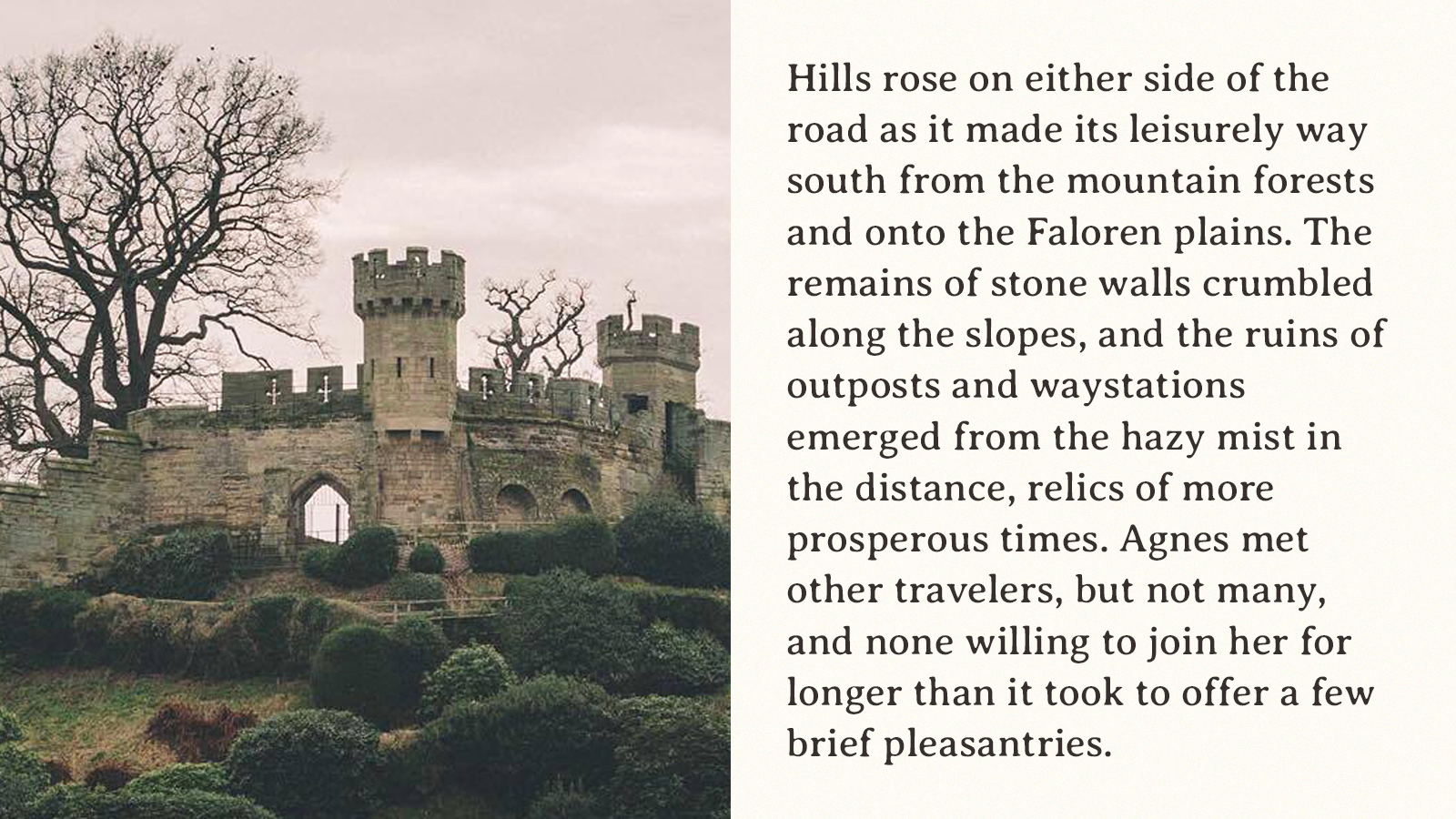
Agnes returns to Faloren Castle under the escort of her secretary Myla, who has been searching for her. She immediately goes to see her father, who is bedridden from a lingering illness. Her cousin Galien meets her at the door. After sending his friend, a courier and skilled warrior named Caelif, to track Agnes’s whereabouts, Galien conspired with Myla to hide the princess’s abduction. He informs Agnes that Caelif has already reported back to him, but he doesn’t ask about the demonic boar. As she looks in on the sleeping king, Agnes reflects on the decrepit state of Faloren Castle while mentally preparing herself to resume her normal duties in the morning.
. . . . . . . . . . . . . . . . . . . . .
This chapter presents the bleakness of the status-quo world to the reader. There are no people on the roads. The castle town has seen better days. The castle itself is falling apart. The king is dying.
Fhiad parted ways with Agnes at some point before the start of the chapter, and she seems to take it for granted that he won’t find anyone in his home kingdom of Erdbhein. This presents a mystery: What happened there? In a later chapter, Agnes will explain what she understands about Erdbhein, but the truth is worse than she fears. Erdbhein has gone full Dark Souls, and it’s filled with ruin and blight and zombies.
In terms of the “Save The Cat” story structure, this chapter establishes the internal debate of the main character. Agnes wants to leave the kingdom of Faloren, but she feels that she can’t. In the next chapter, the reader will see that she takes comfort in routines, especially when these routines make her feel smart, powerful, and in control. She ends her debate with herself in this chapter by saying that she needs to concentrate on “work,” which she’s obviously using as an excuse for not allowing herself to imagine an alternative to her current situation.
This internal debate makes a lot of sense to me personally, as I can definitely relate to Agnes. I was driven by a need to be productive, and I was always busy. My work routines made me happy at the time, but they weren’t sustainable. This is all the more true because the constant activity distracted me from more important issues, namely, that there was something deeply wrong with my work environment.
I had to go through the cycle of blaming myself for poor working conditions a few times – and I got very, very good at it – before I realized what it was. I thought I could somehow fix things by working harder, and damn did I work hard. The realization that the cycle itself was the problem was extremely liberating.
I’m not saying that we should all quit our jobs to live our best lives or whatever. Nobody has the money for that. Rather, I think it can be useful to consider a shift in mindset, and it’s important to take time to allow room for new ideas and new perspectives.
I also think it’s worth considering that some things aren’t salvageable. You can try to keep the lights on, but any effort you expend will only yield diminishing returns. Sometimes it’s better to acknowledge that something is rotten and then simply allow it to decay.

 Digital Fantasy Diary